Or, Star Wars: Agent of the Empire-Iron Eclipse, to give this new 5 issue mini-series its full name. I must say, I was pretty keen to read this, although the majority of my admiration for Star Wars has been tied to the original film trilogy, Dark Horse have shown that they are a very worthy gatekeeper of George Lucas’ creation.
Since 1991’s Dark Empire they’ve produced some great comics set in the galaxy far, far away and have covered many new characters and eras. Writer John Ostrander has written a lot of those comics, including Legacy, and February’s Dawn of the Jedi series which is set to do exactly what the title says.
Agent of the Empire brings a great, swashbuckling, James Bond level of derring do and it’s such a perfect fit that this debut ish will remind many of how they felt after seeing the first film back in the day. Focusing on secret agent Jahan Cross, who works for the evil Empire to give this two unique points of view is a daring, yet creatively satisfying decision. I mean, “Stormtroopers are the Empire’s hammer. This man is its scalpel.” How cool is that?
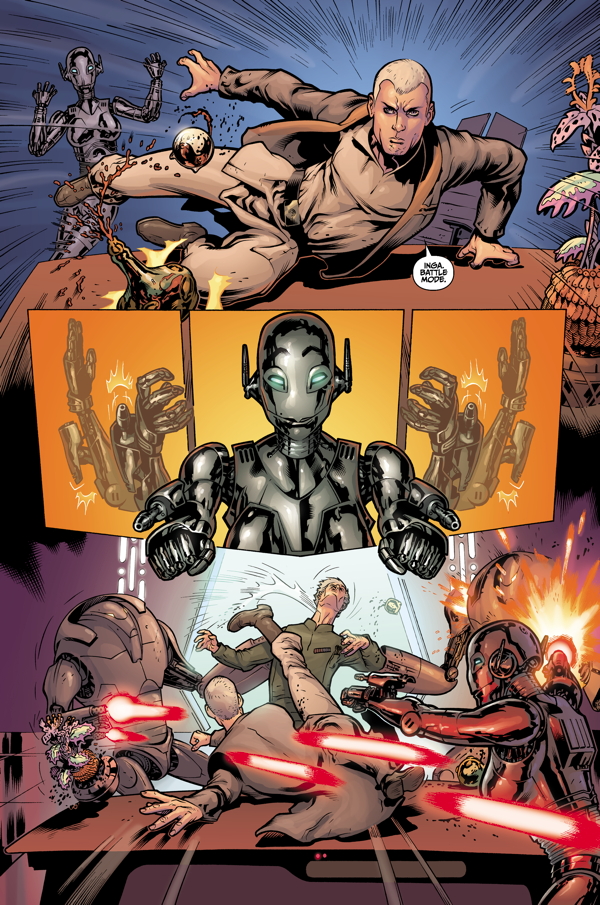
We are introduced to the suave Cross as he accuses a Colonel of dealing in the black market for his expensive tastes. It’s a great scene in which Cross’ status as an Imperial Intel agent (kind of like Internal Affairs) is established and is swiftly followed by an even greater action scene in which Cross vaults across a table and orders his faithful robotic servant IN-GA 44 to go into battle mode. Handy.
The next few pages unfortunately slow right down, as Cross reports to his superior and lots of exposition unfurls about what the Iron Eclipse is. A few pages later though and we are introduced to an obvious Bond homage in the form of the snake-like Alessi Quon, who is essentially the Q, or gadget provider, to Cross.
Ending with a cameo from two of Star War’s most loveable characters seem slightly out of place, but Ostrander handles the pair splendidly, so it’s not as awkward as it could be. Cross, although he works for the bad guys, is a likeable lead. Star Wars already has a multitude of crazy cool characters, but Cross can definitely now be added to that list.
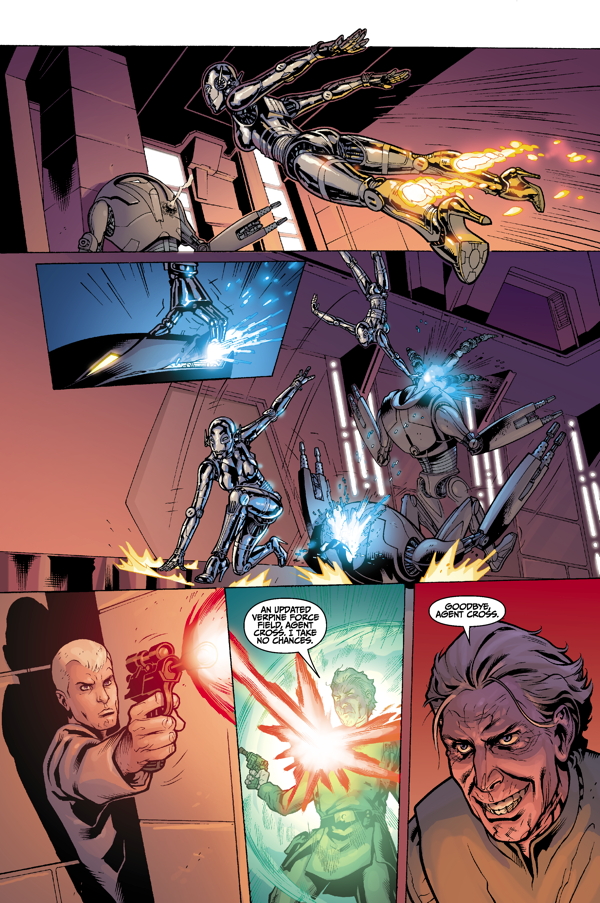
French artist Stephane Roux’s work has always been deft, light and packed with motion. This is a rare interior art assignment, as he’s mostly known for his great covers for DC Comics on runs like Birds of Prey, and Supergirl. Unfortunately he won’t be doing issues 3 and 4, but will be back for the concluding 5th issue. His style fits perfectly with this unique approach to Star Wars. Roux brings a great sense of playfulness to the characters’ interactions, fun to the hectic action, and gorgeous spectacle to the universe spanning settings.
This is a great premiere of another bold entry in this sci-fi franchise that proves there’s much life in the galaxy yet. Although it briefly falls into the trap of setting up the series premise with some slightly boring and lengthy dialogue at times, Ostrander and Roux bring an entertaining charm that promises more great visuals and excitement in the remaining issues.
We all have one of those friends who just doesn’t ‘get’ Star Wars. Give this issue to them and watch them change their minds as they see the light (side of the Force, that is).
You can catch a preview below and Ostrander’s rundown of this series’ main players here.
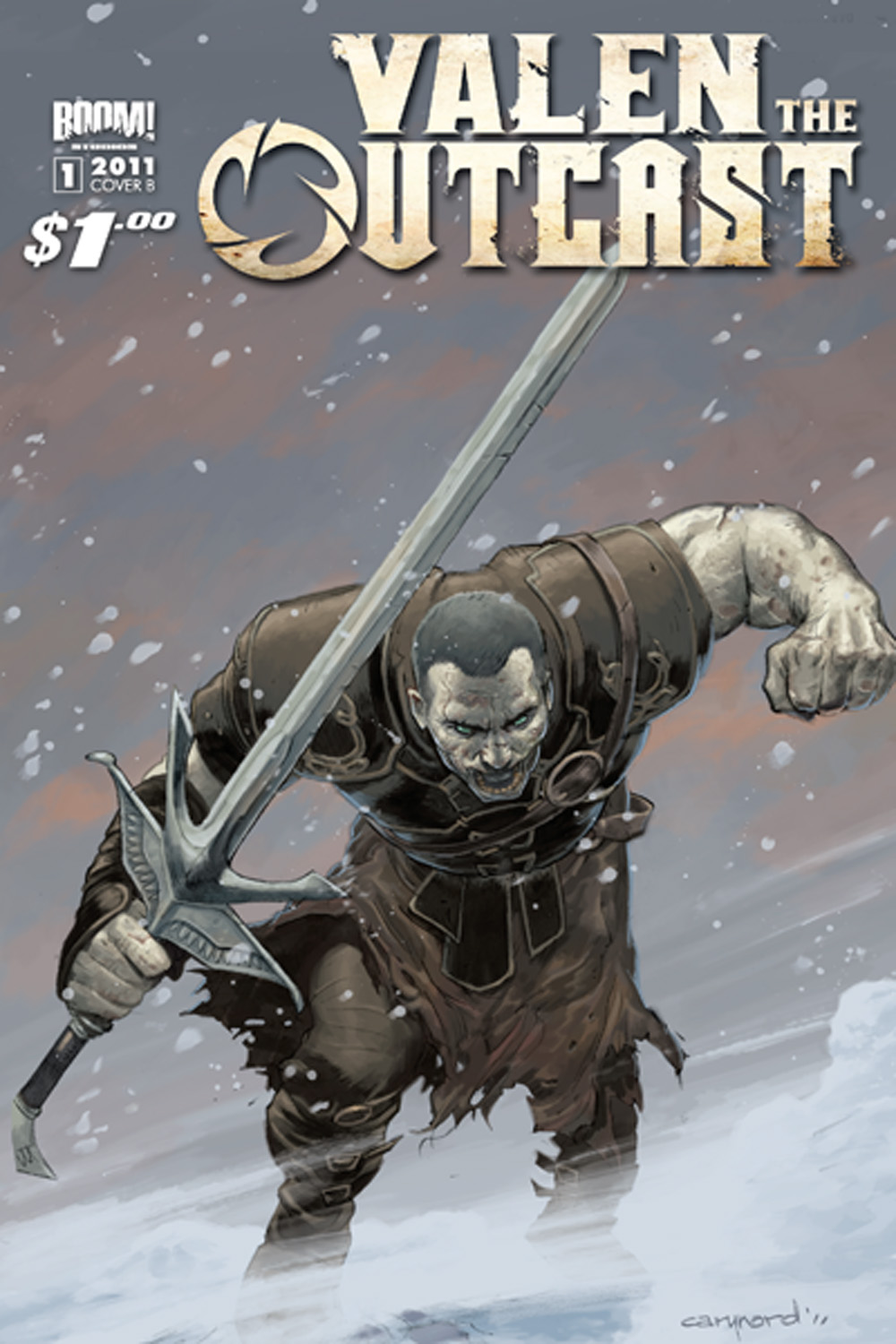
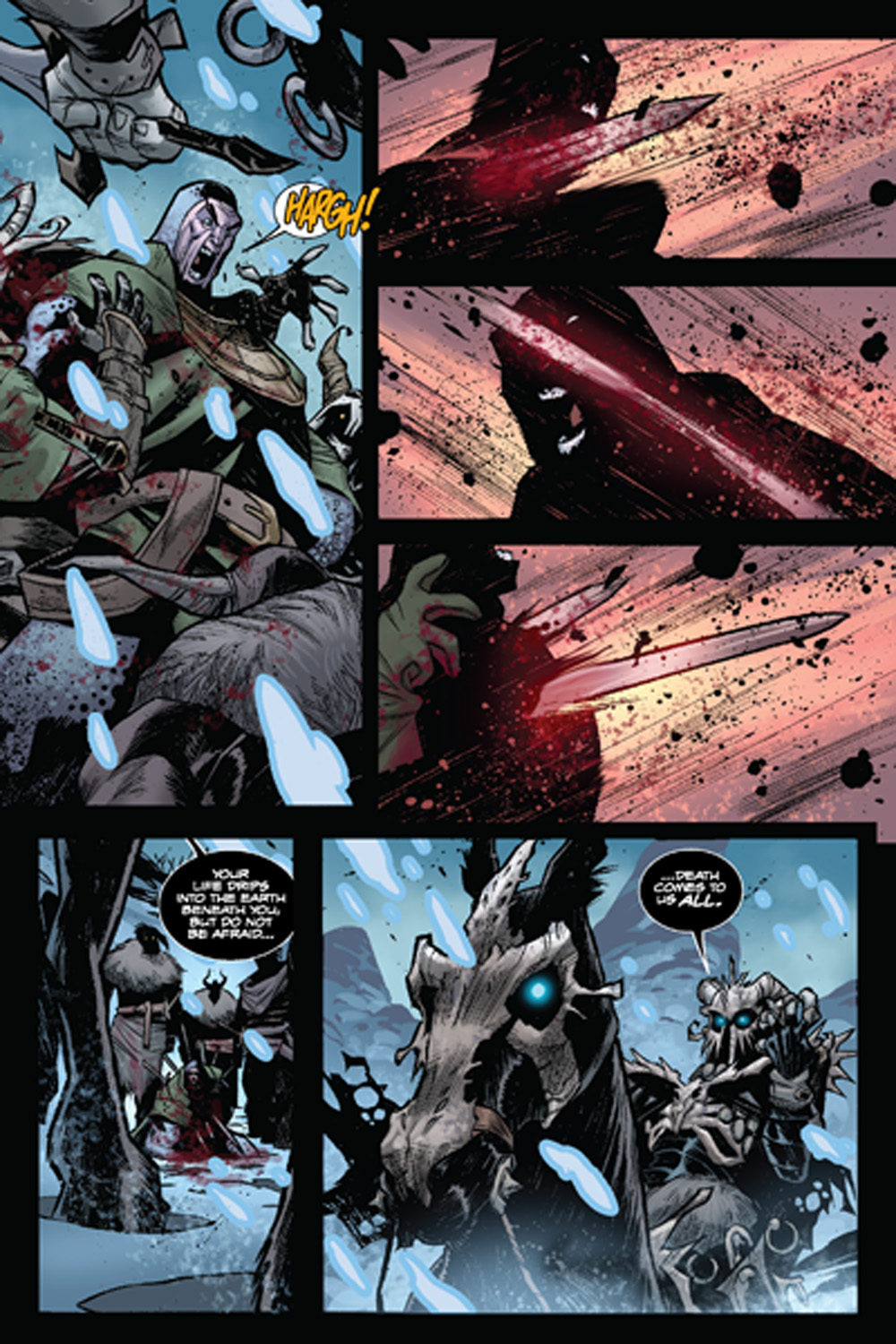
Originally titled simply Outcast, this new series debut is only $1, and do you ever get a lot of bang for that buck! Hyped as “undead Conan,” this new BOOM! Studios title written by Michael Alan Nelson with art by Matteo Scalera (Deadpool) lives up to that cool description with a rousing tale, and a fair bit of bloodshed.
Things kick off with King Valen Brand of Oakhaven as the last man standing of his armies, being captured by his enemy, the necromancer Korrus Null who tells the defeated ruler that he doesn’t want his kingdom, but “something else entirely.”
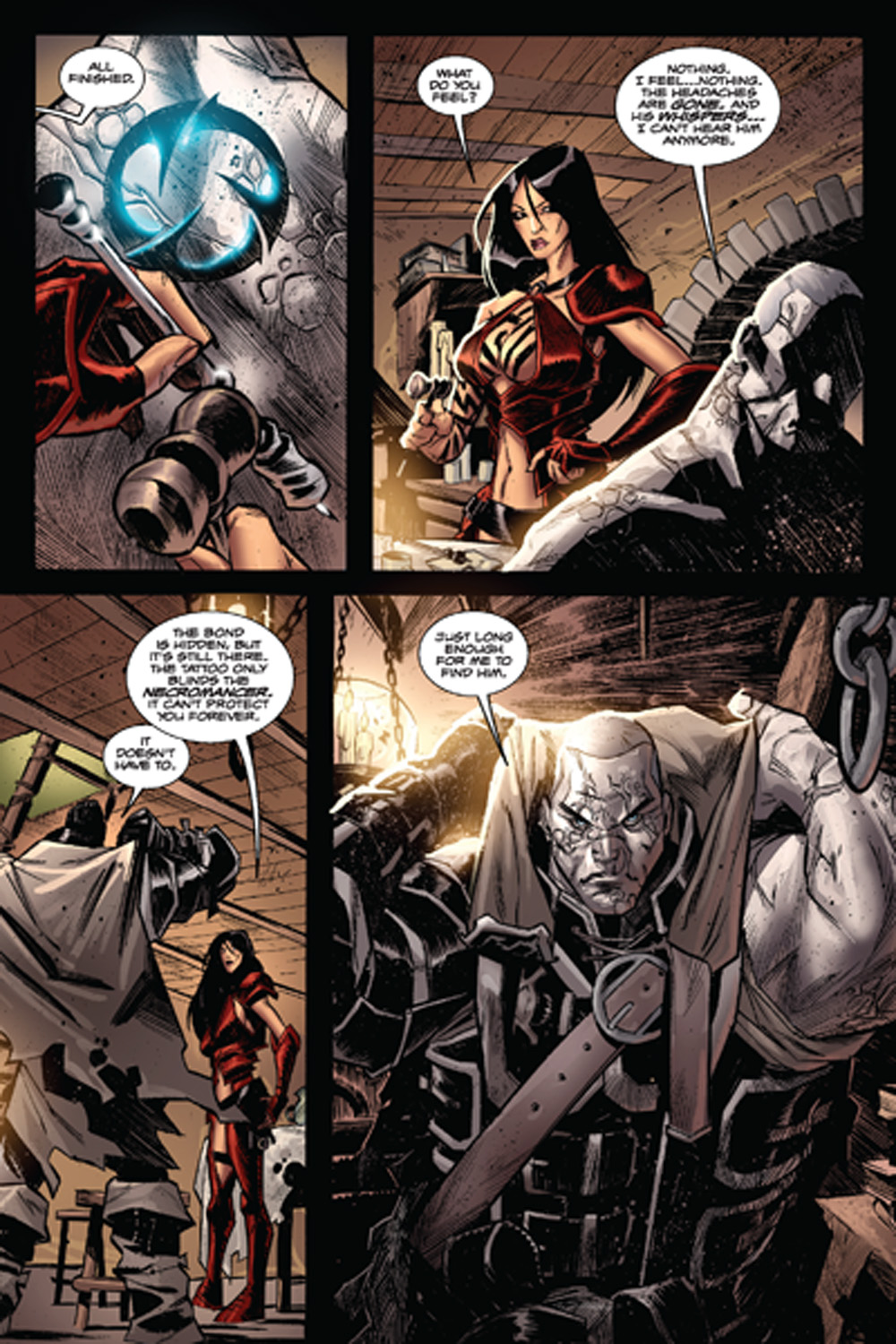
Flashing forward Valen is alive and well (sort of) and has just received a magic tattoo from the lovely Zjanna who is none too supportive of his death wish to reclaim what was once his. Through the next few pages we learn that Valen is indeed a member of the living dead and just wants his soul back.
It’s obvious Nelson is having a ball here, with a daring tale to be told and lively characters thrown together. I even noticed a subtle Star Wars, and Aliens, reference. Seeking the shifty Alexio Cordovan out from a rowdy tavern to be his guide through the dangers of Wraithendal, the pair aren’t off to a great start, but Valen finds an opportunist who gives him what he’s after and leads him to well, danger.
An unlikely fellowship is forged and the adventure begins, though Null has a surprising secret weapon.
Nelson does well to not cram in a lot of mythology and background information of the main cast. It’s done organically through the entertaining story. We have the comedic character, the sexy character and Valen, the outcast in every sense of the word. Having a murdered king who is now living and feared by the people he once ruled, and soldiers he once fought beside, is a great idea and gives a real emotional weight to Valen’s noble, though dangerous, quest. He’s a typical ruler, but also a man of quiet focus and inner conflict, willing to make the most of his current existence.
This is a great example of how to craft a premiere issue of a new series. It’s easy to follow, with enough hooks to grab the reader and bring them back for the second issue. It did take some digging, but apparently this is an ongoing series, rather than BOOM!’s typical mini-series, but this concept is certainly strong enough to live up to that scope.
Nelson is one of comics’ most underrated writers, who is consistently entertaining, as he’s proven with 28 Days Later, Hawks of Outremer and many other series, including one of my faves – Hexed. In fact, he’s been responsible for a lot of BOOM!’s output in the last few years.
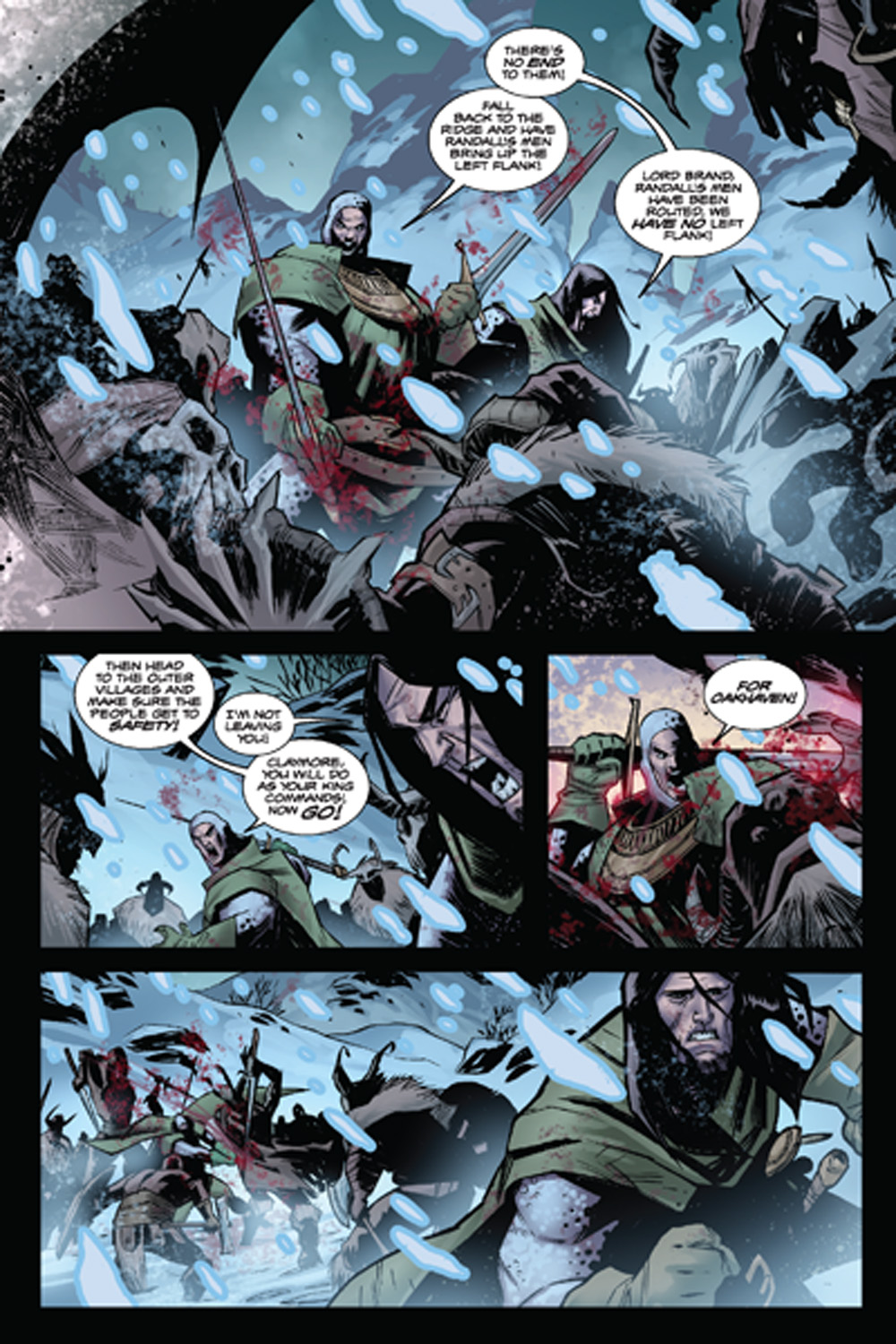
Scalera’s art is dynamic and expressive, especially during the well realised battles, and although the background details aren’t ornate, he fills this fantasy world with great costume design and manages to make the tavern, the forest and the village square all retain the look of the sword and sorcery setting. Archie van Buren’s colours bring much life and intensity when needed too, particularly during Zjanna’s hectic fight with a few of Null’s soldiers.
At only $1, you’d be wise to pick this great action packed fantasy debut up.
53 mins. We all have one – a pile of shame. In other words, comics that have been sitting, and gathering dust, on our bookshelves for far too long. We discuss our own examples, and the reasons why they’ve remained unopened. Also, Brigitte Nielsen’s body of work.
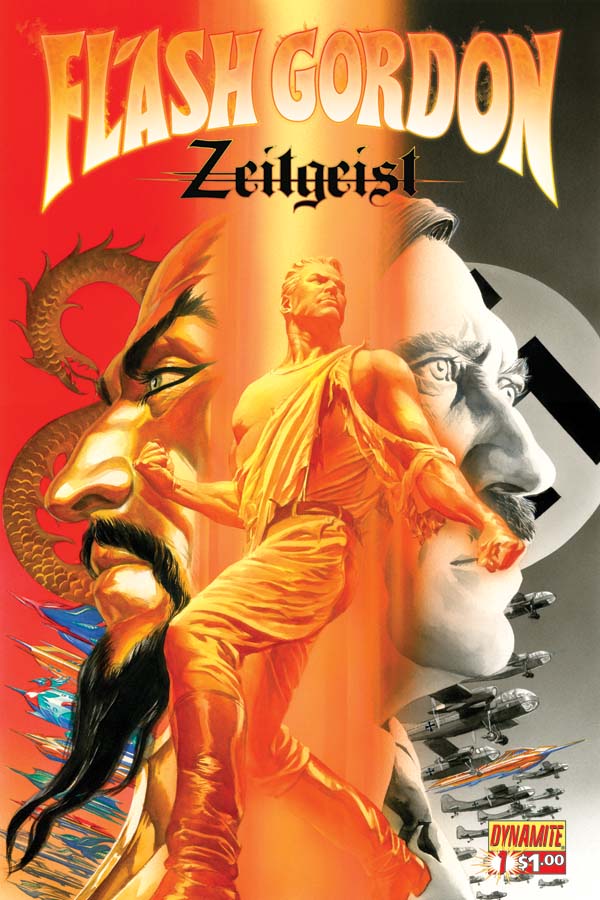
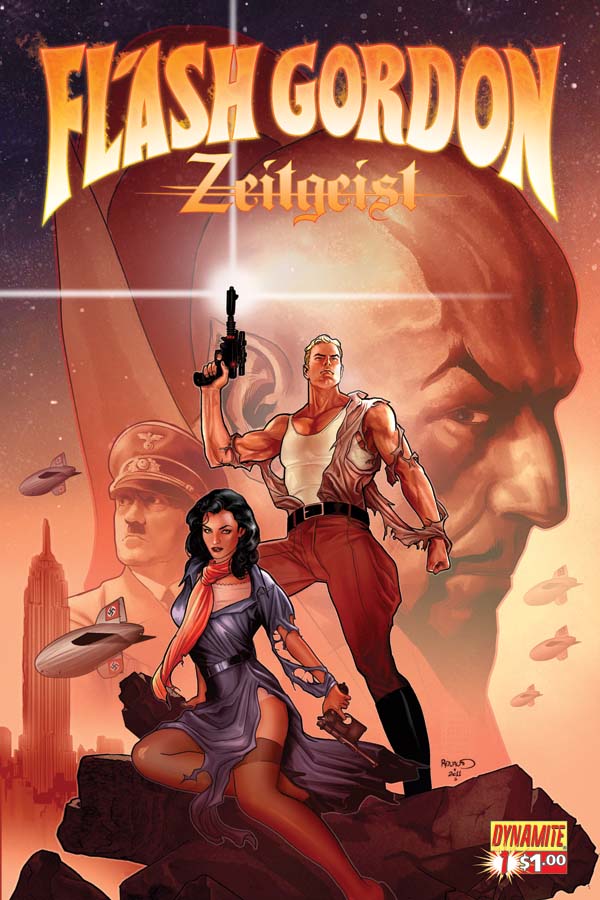
I was a tad cautious about this new acquisition by Dynamite after several other classic heroes (Lone Ranger, Green Hornet,etc), as there’s already a Flash Gordon series from publisher Ardden, and has been for a while. (In fact, you can read their #0 and #1 issues for free.) However, this debut issue (at only $1!) is awesomely rousing with a great focus on action and drama.
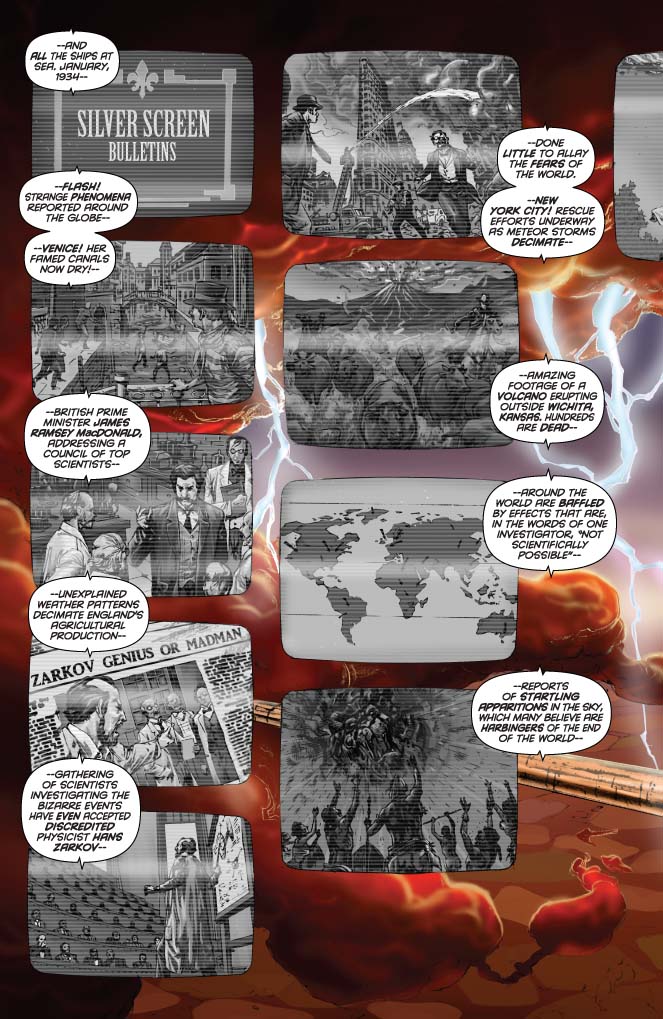
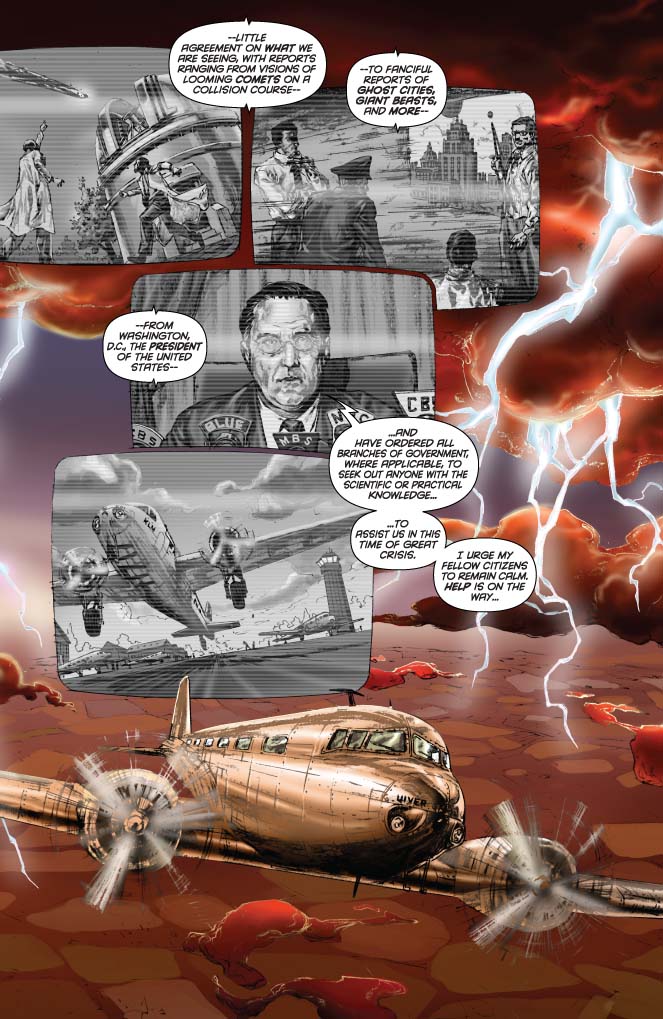
Setting the story in 1934 (the year of the adventurer’s debut, courtesy of Alex Raymond) was a bold, but wise move. Not only does it set it apart from Ardden’s modernised take, it also gives Flash Gordon a unique flair for adventure, much like The Rocketeeer or Indiana Jones tales set roughly in the same era, do.
We first see Flash when he’s jumping from a burning plane, with cartographer Dale Arden in his arms. Handy captions introduce us to all the main players and Flash is instantly likeable due to that charming ’30s style and the fact that he’s a polo player once more. Flash and Dale are on a mission to find reclusive scientist Hans Zarkov. They do and he’s wonderfully crazy (well, at least a little bit). Zarkov believes there’s a way from our universe to others, and that inhabitants of said outer worlds have been visiting Earth for recruitment purposes. One dangerous space shuttle journey later and Flash and Dale see his point. On the last few pages three rebellious Mongo citizens visit Germany to hunt down Ming ally, Hitler. This was a pleasant surprise, adding one more layer to this daring tale.
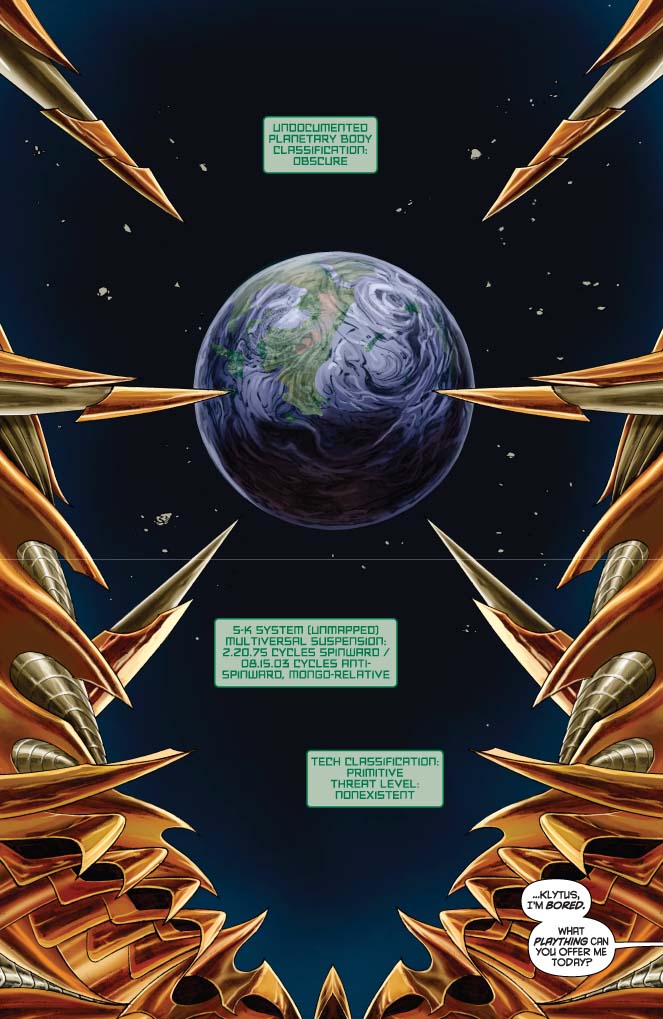
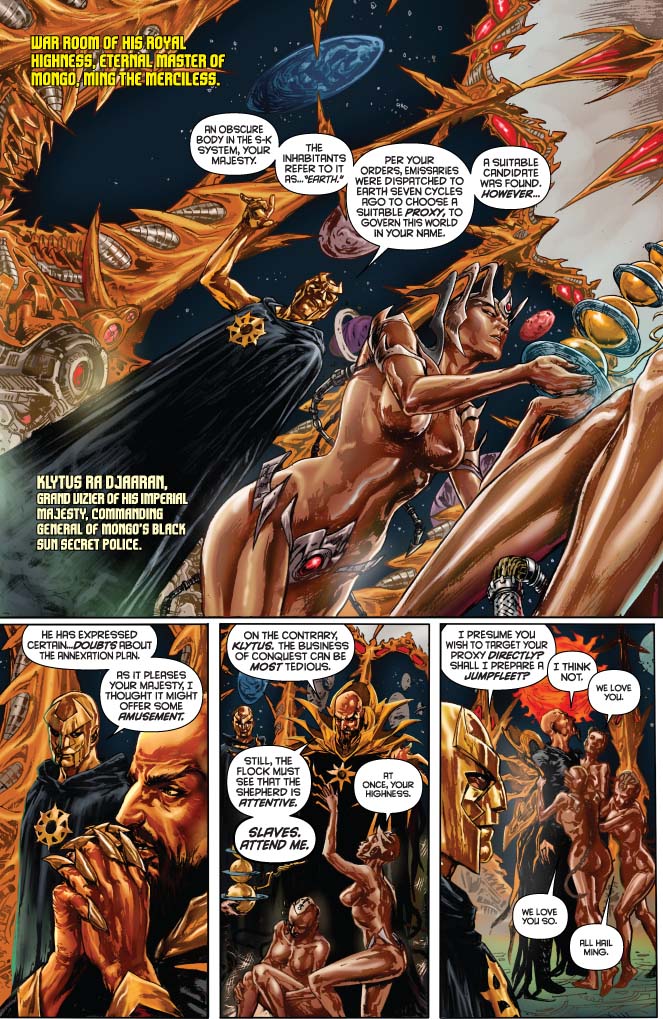
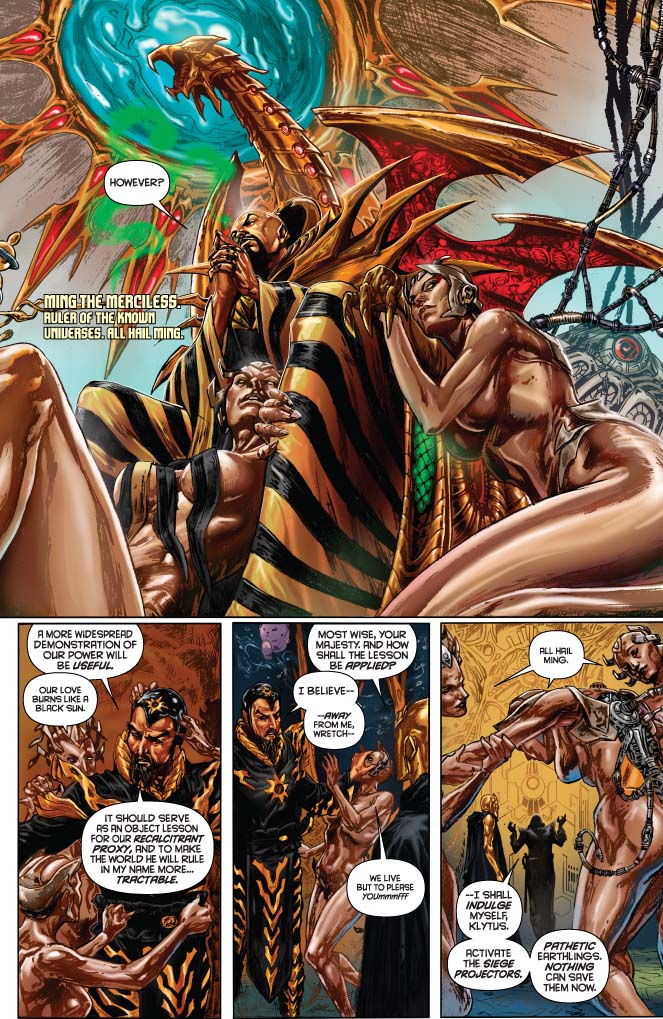
Artist Alex Ross (Kingdom Come) has long been a fan of the character and an interview with him even shows up on the DVD of the 1980 film. His love is evident here in his character designs and art direction, a role (as well as variant cover artist) that has kept him busy with numerous series over the last few years at Dynamite. Not as outlandish as his designs for the Jack Kirby inspired titles, they evoke classic sci-fi trappings much like the rockets and alien thrones do. Throwing Ming’s snivelly right hand man Klytus from the film was a nice surprise too, and Ming really lives up to his Merciless title, with his disdain for pretty much everyone, including his slave girls and the entirety of the human race it would seem. More of a nuanced character and not at all a stereotype, Ming is like Darth Vader in Episode IV. We don’t see much of him, but we see enough to know that he’s a calculating despot.
Daniel Indro’s art is a perfect fit. Similar to Ross’ pencils, but with a dynamism all his own, he skimps no detail. The script asks him to create aliens, Zarkov’s busy lab and high drama fuelled emotion, and he does it all splendidly. In particular, the escape in Zarkov’s experimental shuttle is a very well crafted sequence. I’m looking forward to seeing more of his work and it looks like we’ll be witnessing both Earth and Mongo scenes. Excellent.
Writer Eric Trautman (who plots with Ross) does well to craft an entertaining story, with just as entertaining central characters, despite there being several of them. It’s a fast ride and there are no dull moments. From Flash’s take charge attitude, Dale’s far from damsel in distress attitude, and Zarkov’s crazed brilliance, he captures the essence of these well known characters in a superb fashion.
Hitler is no surprise, as he’s shown on the cover, and is hinted that he’s a Ming supporter. If done well, this concept could work, with a nice history/fantasy blend, though I’d imagine there may be some that would cringe with the very idea, but it’s too early to tell just yet.
Those familiar with the awesomely cheesy 1980 film (with the great Queen theme song) will fondly recall the opening lines here and it’s obvious that the creators are well aware of Flash’s vast history. This is no duty old reboot that sits awkwardly with today’s superheroes. This is a new Flash Gordon. He’s almost the same as the old one, but better. He’s a hero for today, and he’s highly entertaining.
58 mins. Don’t suffer from space sickness or hard radiation, but listen to our discussion about manly heroes, jetpacks, rayguns and the lost art of adventuring. From comic strips to comic books we look at some of the genre’s best tough guys and their unique tales. Also, Timothy Dalton and a tree.
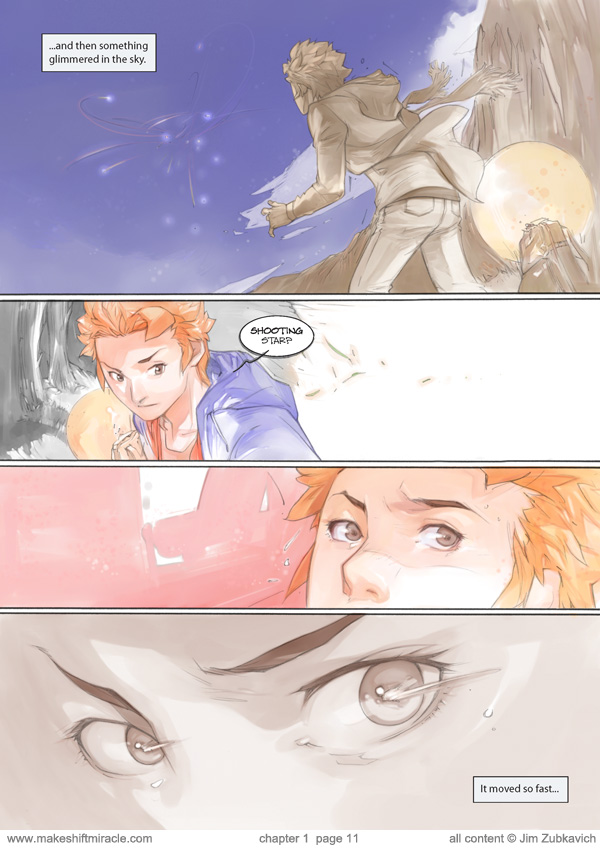
This is another one of those comics that I’ve been impressed by and have been meaning to give it its due. Makeshift Miracle began as a webcomic in 2003 and is now back, thanks to MM writer Jim Zubkavich (of the equally entertaining, though different entirely, Skullkickers from Image) has been promoting it by asking, well…anyone to read and distribute it as a PDF or CBZ. It seems to be working, as new readers are doing just that, me included. I don’t read any webcomics regularly, so having the entire chapter in one place is, like the art here, very attractive. This revisitation has seen Zubkavich enrich the story, with the addition of new art by Shun Hong Chan.
Zubkavich touts this as a publishing experiment, hoping to build an audience online before it hits print from UDON (publisher of Zubkavich’s great Street Fighter comics) mid next year. Webcomics such as Axe Cop and Dr McNinja have found a paper home at Dark Horse and with the impressive work on display here, this deserves just as much success as those two series.
This isn’t a comedy however. Zubkavich has proven he knows how to do that with the aforementioned fantasy Skullkickers, so with Makeshift Miracle he focuses on drama and mystery. Titled Impact (a term which will surely have more than one meaning in future instalments) this debut focuses on high schooler Colby Reynolds. He’s sick of the selfishness of those around him and has started a private blog to let his frustration out. It’s this diary which acts as the narrative device for the loner and gives us a glimpse in to who Colby is. Before things become too introspective, Colby follows something guiding him from within to a valley-set town, which he declares to be, “calm and beautiful,” and that is an apt description for Shun Hong Chan’s art.
Zubkavich wisely pares down the text on each page, giving the visuals the focus. Chan’s art is as light and delicate as a soufflé, and the fact that it’s not realistic or flamboyant makes it even more dazzling. The delicate, watercolour-like approach and restrained manga flair make this fit snugly into the fantasy/drama feel it’s striving for. If you like Dustin Nguyen’s art, you’ll love this.
Not much happens, story-wise in the first 18 pages of this debut chapter. Essentially Colby travels, thinks about his family (with nice black and white flashbacks) about his family, goes to a quaint town in the middle of nowhere, and sees a beautiful naked woman fall like an asteroid at his feet. Zubkavich so far wisely puts the spotlight on Colby and the girl and it’s more than enough to be captivating.
The second chapter of Makeshift Miracle began in early November and is updated twice a week. You can download chapter 1 right here.
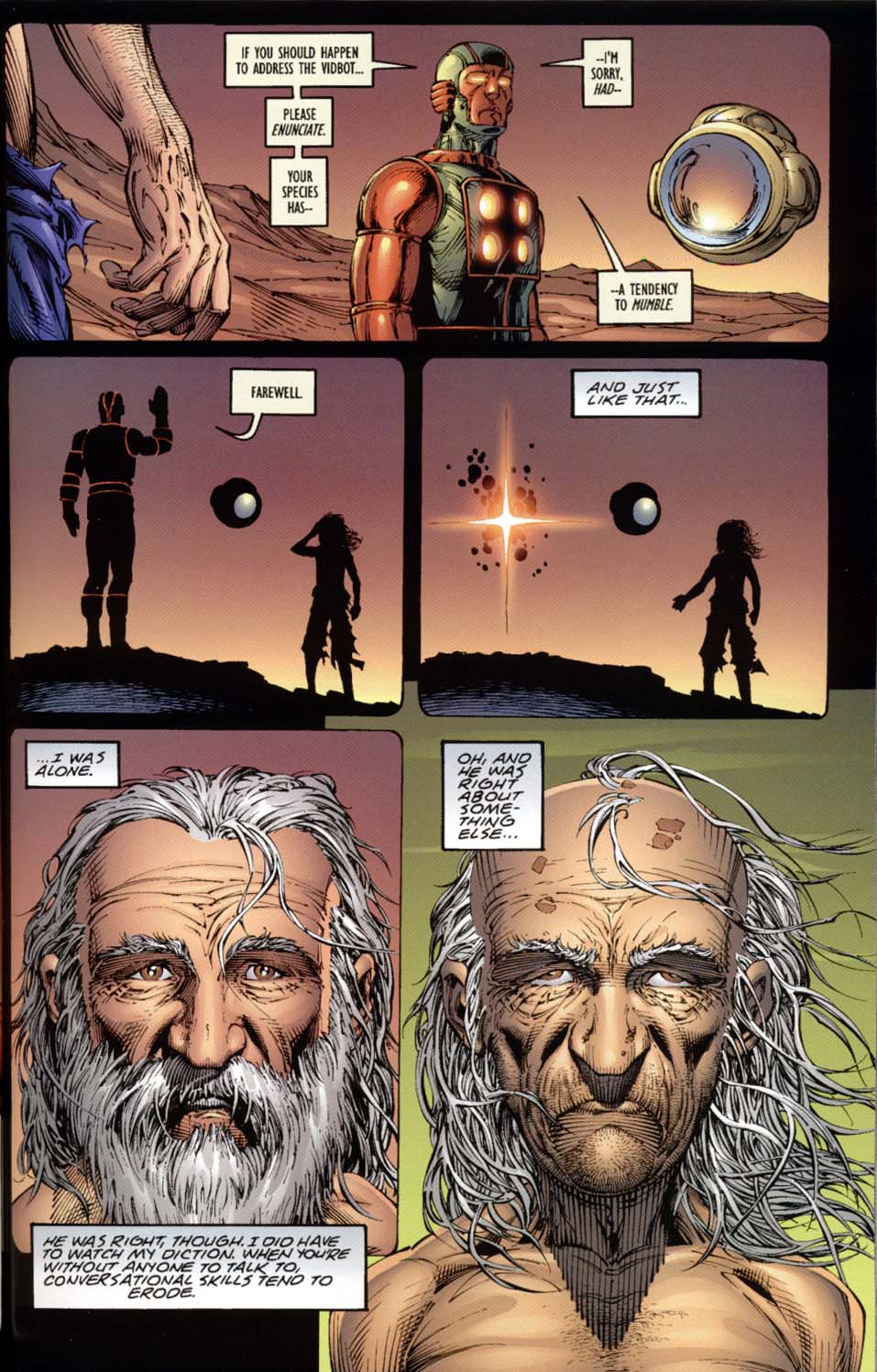
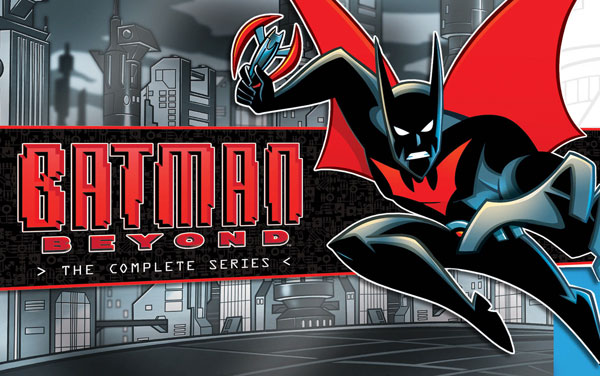
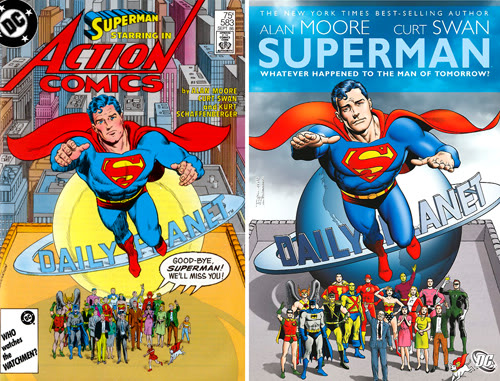
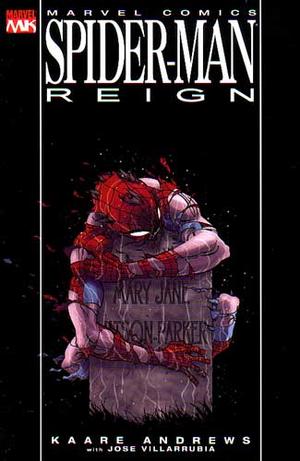
50 mins. The opposite of origin tales is this week’s focus as we examine various superhero future stories, both classic and new. What happens to our favourite characters decades into the future when they’re older, greyer and grumpier? Also, Colin Firth in a fountain.
I must confess that I haven’t read a BOOM! comic for a while. In fact, the last series was DuckTales for our similarly themed podcast episode.
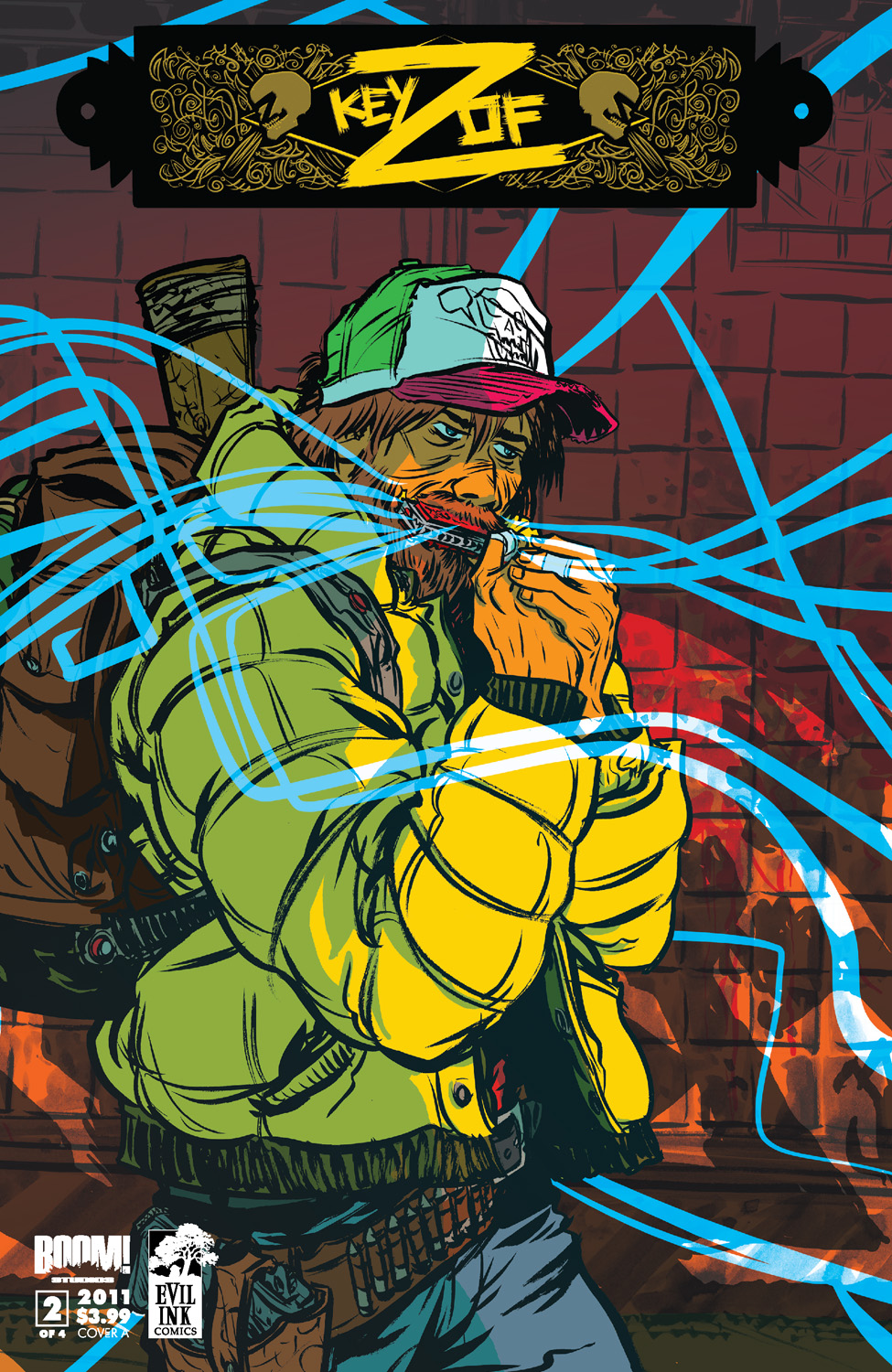
Key of Z intrigued me though, written as it is by partners Claudio Sanchez (of band Coheed & Cambria) and Chondra Echert, the pair behind writing the bold Kill Audio series about an immortal troll. Plus the artist here is Aaron Kuder is also responsible for Sanchez’s The Amory Wars. Time for another confession – I’ve read little of either, but I know both were filled with big ideas and daring art, so their take on zombies I had to see. Yes, I know zombies are the flavour of the month, or rather year, but having not been exposed to much Walking Dead (although I’m keen for Australia to get the TV series), I thought it was worth a look.
Opening with Nick Ewing and his family having a lovely time during Christmas Eve, they have their pleasant bonding interrupted by a zombie Santa outside their window, which is as freaky as it sounds. Jumping forward to 2012, the undead epidemic is underway and New York is divided into three fiefdoms, or Houses who live in the stadiums of the Mets, Yankees and Madison Square Garden. It’s an interesting setup to what could’ve been yet another predictable apocalyptic tale. Jumping forward to 2016, Ewing is out getting some fresh air (whereas most survivors prefer the safety of their sporting stadium). Seeing Ewing grow a beard and muscles over the span of 5 years is a nice and realistic touch, and it’s here that he meets Eddie Alvarez, a skinny, scared collector who lives at a library, and is virtually ignored by his own gang. They slowly befriend one another and exchange recent life stories before a detour to a cave of antique weapons and a surprise attack by a mass of flesh eaters.
Editor Matt Gagnon’s letter mentions what is fairly obvious, with comic DMZ, Walking Dead and cult film The Warriors being an influence on this story, and I get the feeling that only being vaguely aware of those 2 series has helped me enjoy this more. Gagnon also mentions that Ewing’s wife and boy were murdered, although that’s not overtly stated in this first issue.
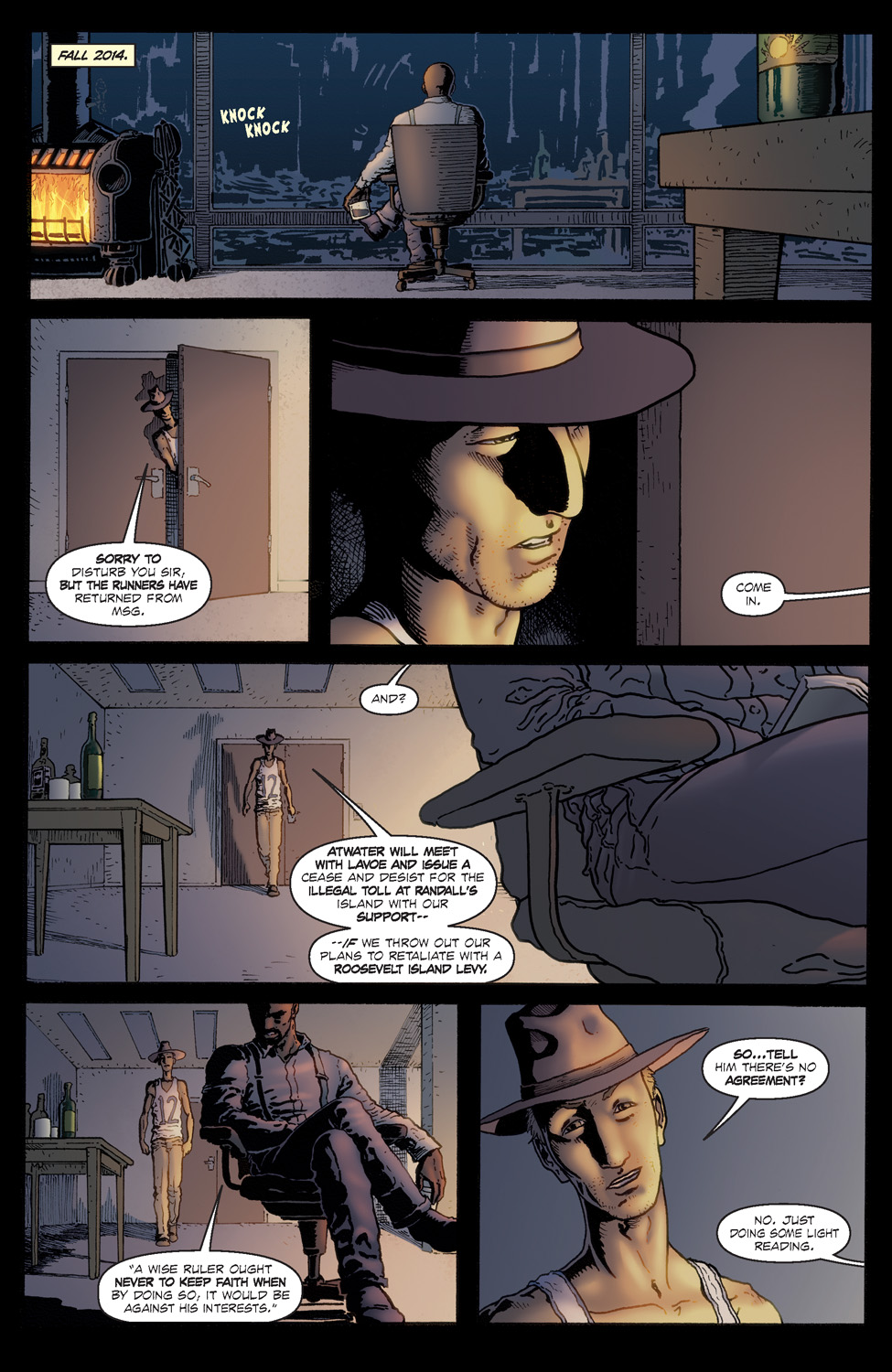
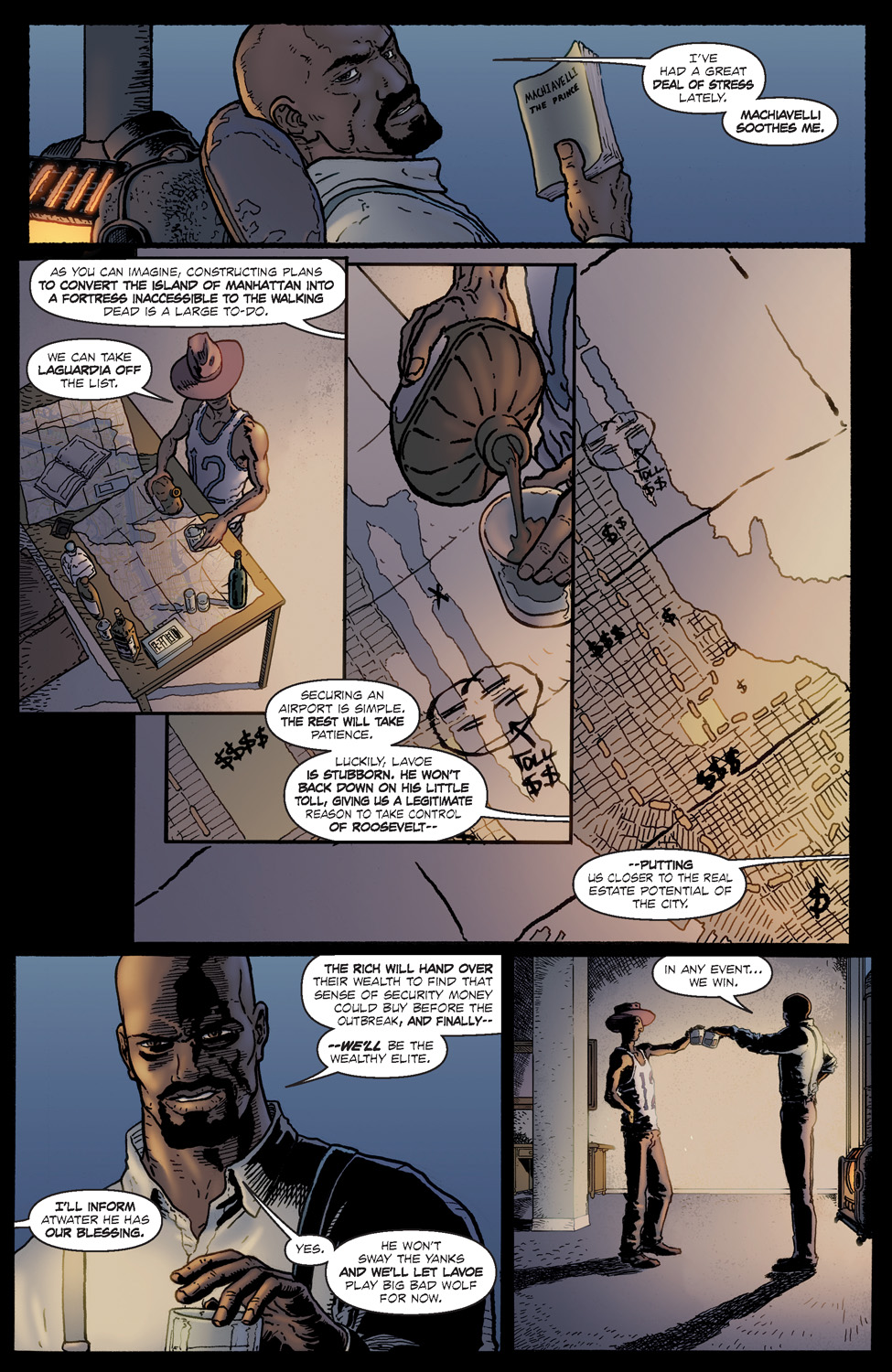
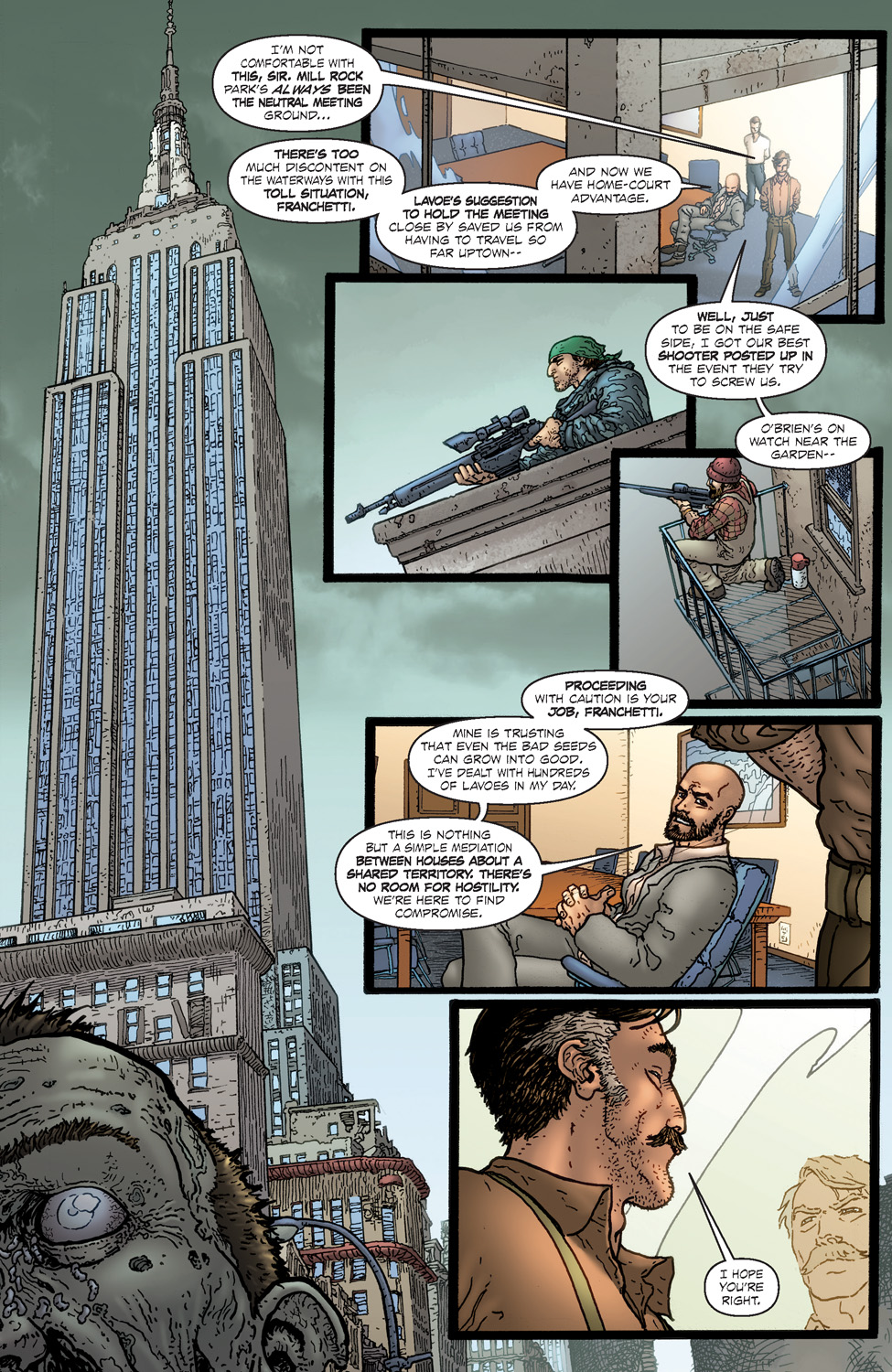
In the second issue which is set two years before the debut ish, we get to know the three houses more. Atwater is the more educated leader and reminds me of Morpheus in the last Matrix film, whereas Lavoe is far less interested in the needs of others and resembles Scarface, in his tax charging and brutal regime. The pair meet for a treaty and Lavoe bluntly states that he isn’t interested in any altruistic deal with Atwater and Jackson. In the aftermath of the devastation, Ewing learns that a silver harmonica his son gave him on that fateful Christmas has magical properties. Well, perhaps magical’s not the best word, but it’s certainly unique and when played properly, give shim the powers of a putrified Pied Piper, bringing the zombies right to him. It seems like an odd ability, but I guess Ewing is stronger and faster than the zombies, so at least he knows where they are and can destroy them so as not to be surprised later.
Ending with more interaction between Ewing and Alvarez, and a mission for revenge steers the last two issues of this mini-series to a good place.
Kuder’s art has to be mentioned. With its fluid linework, and simple, yet effective details such as textures it evokes Frank Quitely. Coupled with Charlie Kirchoff’s col0ur choices (subdued and quite hazy during dramatic scenes, bold during the zombie bashing) it looks pretty and never ventures into bloodthirtsy territory. Yes, there’s teeth flying and charred corpses, but it never looks over the top.
These 2 issues mark the halfway mark, but I’m already sold and I’m glad I let my curiosity get the better of me. Key of Z #1 and 2 are out now, and #3 will be released on December 28.
53 mins. We analyse the purpose of the love-interest character, how they play off of the heroic lead, and what makes the archetypal Lois Lane memorable while others are forgotten. Also, Jean Claude van Damme. Just because.
The female love interest/damsel in distress has a specific role to fill in the stories of comics, and most notably superheroes. We examine the following.
The pulp novels including Doc Savage, and The Shadow
Hollywood’s genre mashing of sorts
Female versions of male superheroes
Peter Parker’s loves, including Gwen Stacy, and his dissolved marriage with Mary Jane Watson
Bruce Wayne’s escorts
The complicated relationships in Crying Freeman, and Preacher
My review of the second issue of this dystopian series from muso/writer Tom Morello is now up at Broken Frontier here. I actually enjoyed it more than the first issue.
This week is fairly indicative of my new comic purchasing habits, with DC Comics and their largely disappointing relaunch taking a back seat to some truly entertaining tales at Marvel.
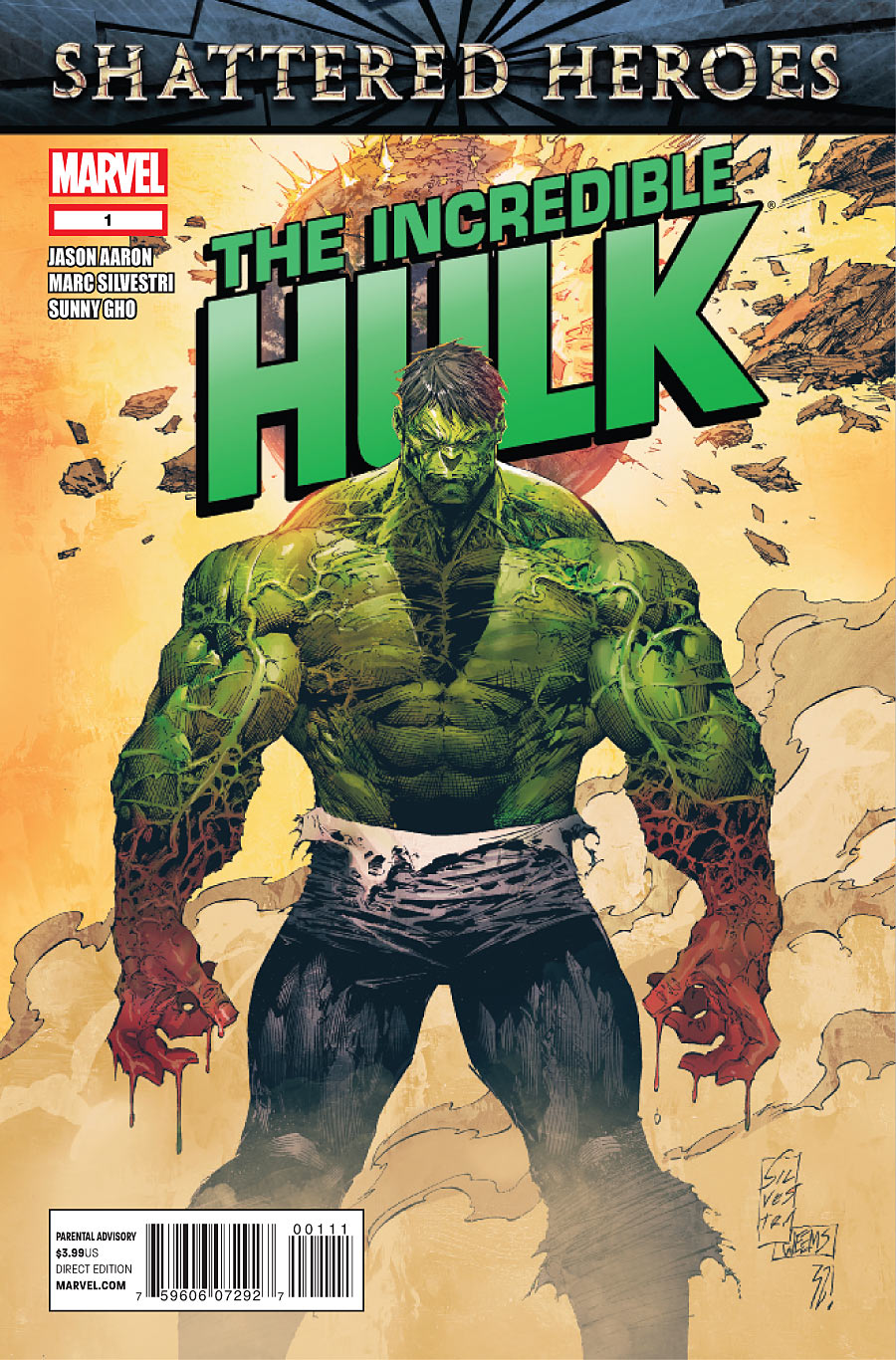
The Incredible Hulk #1. Writer Peter David got me hooked on the Green Goliath, as I began following him towards the end of his stellar 14 year run. Now I’m collecting all the Hulk Visionaries Trades that gather his epic. This new series finds Bruce Banner and Hulk separated, and writer Jason Aaron (Ghost Rider, Scalped) promises to explain how in future issues, as well as just why Hulk is hanging around deep below the earth, and how Banner managed to fund a laboratory in the middle of the jungle for his Island of Dr. Moreau experiments. Guided by Hulk’s Banner hating narration, and begrudging friendship with the mole men he feeds with huge subterranean beasts, is this worthy intro issue. Marc Silvestri’s sketchier style than usual works a treat with the angry action on display, although he’ll be getting help in coming issues. If you’ve been away form the Hulk for a while, this is a great place to return to.
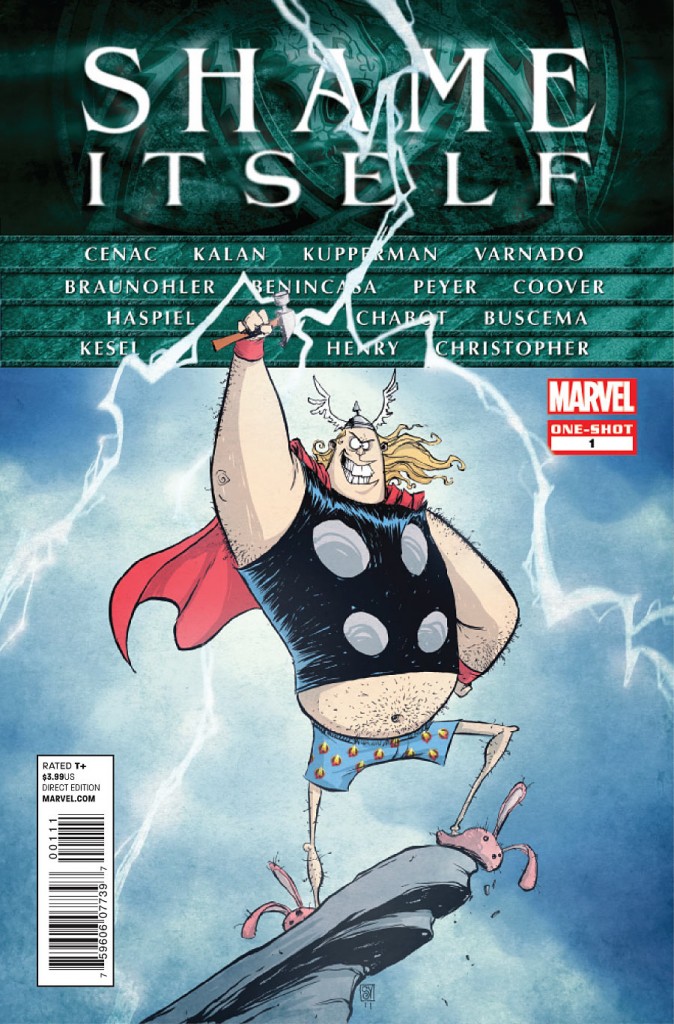
Shame Itself. And now for something completely different. This ish doesn’t takes itself seriously at all, whcih makes it such an enjoyable romp. As an anthology one-shot mocking Marvel’s antics, I found this surprisingly funny. Despite the title, this doesn’t focus on the recent Fear Itself epic that ran throughout Marvel’s titles. Kicking things off with an awesome 5 pager by Victor Varnado and Clayton Henry, it finds various baddies including Galactus, Dormammu and Thanos (“He’s got jewellery!”) all turning up at New York to announce their latest world domination plans and then awkwardly realising that they can’t all rule the world and need some sort of schedule. Elliott Kalan and Dean Haspiel bring us Reed Richards and The Thing’s high school reunion, in which much to “Read’s” (as his name tag suggests) chagrin, Ben Grimm is much more popular than him. A Wy-If, as opposed to Marvel’s alternate universe What If series, by Wyatt Cenac, Kalan and artist Colleen Coover present 5 one page gags that work rather well. There’s a 2 pager prose piece from Michael Kupperman and a piece called “I Hate Peter Parker,” that doesn’t work. Overall, the whole ish does though, but only in the same way DC’s Tiny Titans does – for fanboys who know their stuff. If you’re new to Marvel, you won’t know most of these characters so the jokes won’t work. It’s awesome to see new writers here (a few from the land of TV), all of whom have a clear love of Marvel’s costumed adventurers.
Avengers Origins: Vision. The first in a series of Avenger centred one-shots is this painterly beauty. I’ve never been a massive fan of the avengers, but I do have a fondness for their low-key heroes such as Wonder Man, and this androgynous android. If you don’t know much about Vision, this is a nice teacher, although it won’t bring you up to speed on what he’s doing now. I haven’t seen him in a Marvel comic for ages, so I don’t know if he’s dead or what.
This tale, written by Kyle Higgins and Alec Siegel with gorgeous art by Stepahne Perger focuses on Vision’s creation by the evil Ultron 5, himself a robotic creation of Hank Pym of the avengers. Vision trains under Ultron, learns that his sole mission is to destroy Earth’s mightiest Heroes, which he fails at. He does arrive at a crying Janet van Dyne’s (Wasp) bedroom window and begins silently taking out the team, as Hawkeye, Pym (known as Goliath at this stage), Black Panther rush to each other’s aid. No sign of Thor, Cap or Iron Man though, which is just as well as that’d be too much to fit in this one-shot. Vision is impressed by their heroism and friendship and decides that Avengers aren’t worth his killing mission, and focuses his wide array of powers on his silver creator instead. It mixes some well constructed action and emotional touches as Vision goes beyond his original programming to become something more.
Perger’s art is lush and vivid, and reminded me of Alex Ross’ early work in Marvels. The fight scenes are filled with bold reds and yellows and laid out on the page very dynamically. I hope Perger does more superhero work. It fits in this nostalgic context but the balance of high action and emotion is splendid and would work in any series really.
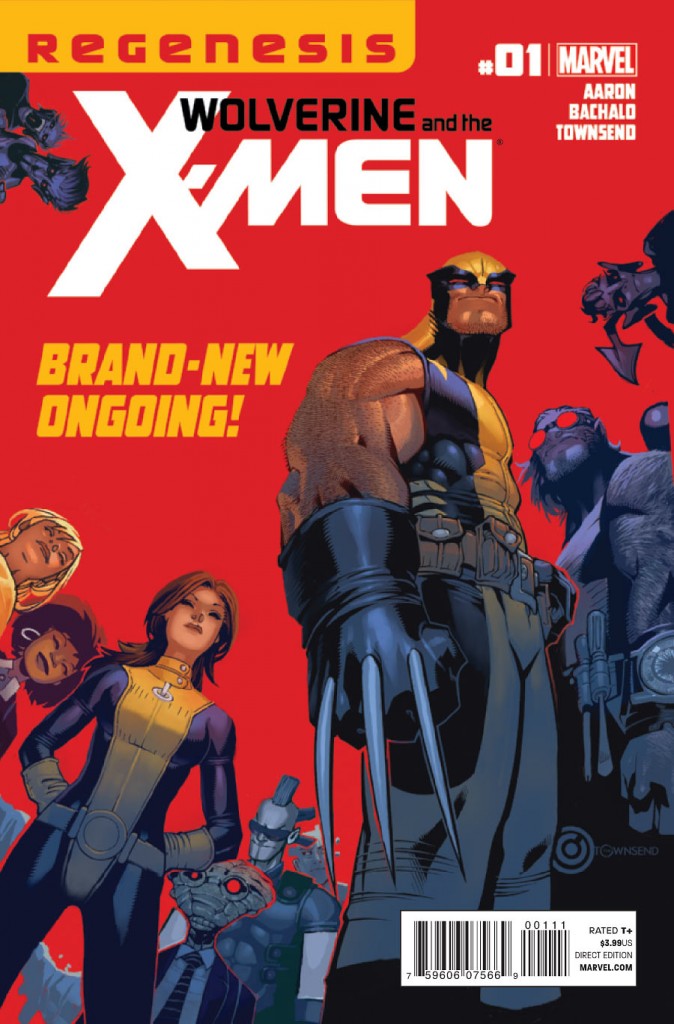
Wolverine and the X-Men #1. No, it’s not based on the cartoon, but is set after the events of the recent Schism mini-series in which Cyclops and Wolvie had an ideological falling out, so Cyke and his students remain on the island of Utopia while Wolvei and his return to their old school, now called the Jean Grey School for higher Learning, in honour of their fallen comrade. This debut was a lot more light hearted than I was expecting, beginning with Wolvie and Kitty Pryde stressing out about being headmasters on the opening day, coupled with the visitation of two inspectors who are unimpressed on their tour with all the dangers around them.
It’s a good intro to the state of the new series and the faculty and students. We see glimpses of Husk, Beast, the once evil Toad (who only wants a bed) and new arrivals Kid Gladiator (his alien father has given the school lots of cool tech) and his bodyguard Warbird. There’s bound to be tension from within and attacks from outside, as Prof. X (he can walk now apparently!) tells Wolvie to expect lots of explosions and to get the number of a good debris removal company. Jason Aaron has done well to fit in humour, and lots of character moments here, and Chris Bachalo’s art is much more refined than his sometimes messy style. The exaggerations and light manga touch work a treat.
Marvel: Point One. This one-shot has been touted as an important pointer to some upcoming Marvel stories, so it mainly serves as an extra-sized anthology hinting at what’s to come. Consisting of 7 different tales, it begins with two explorers looking at the all-knowing Watcher’s records and then has spacefaring Nova (in a new suit that makes him look like’s been de-aged) fighting Terrax before fleeing to warn everybody that the Phoenix force is coming. It’s good to see Jeph Loeb and Ed McGuiness teaming up again, even if it’s for a short tale like this.
Next up is a future set Age of Apocalypse tale in which mutants rule and humans are the hunted species. David Lapham’s scripts works with Roberto De La Torre’s slightly gritty pencils to present an interesting tale that does very well to present a handful of new characters in as many pages. The Scarlett Spider and Yin and Yang tales are OK, but Matt Fraction’s and Terry Dodson’s Dr Strange story gives us a look at December’s The Defenders series (which I’m looking forward to, only because of the creators) and Brian Michael Bendis and Bryan Hitch show Spider-Man and Hawkeye fighting a losing battle against a few vicious Ultrons in their intense style.
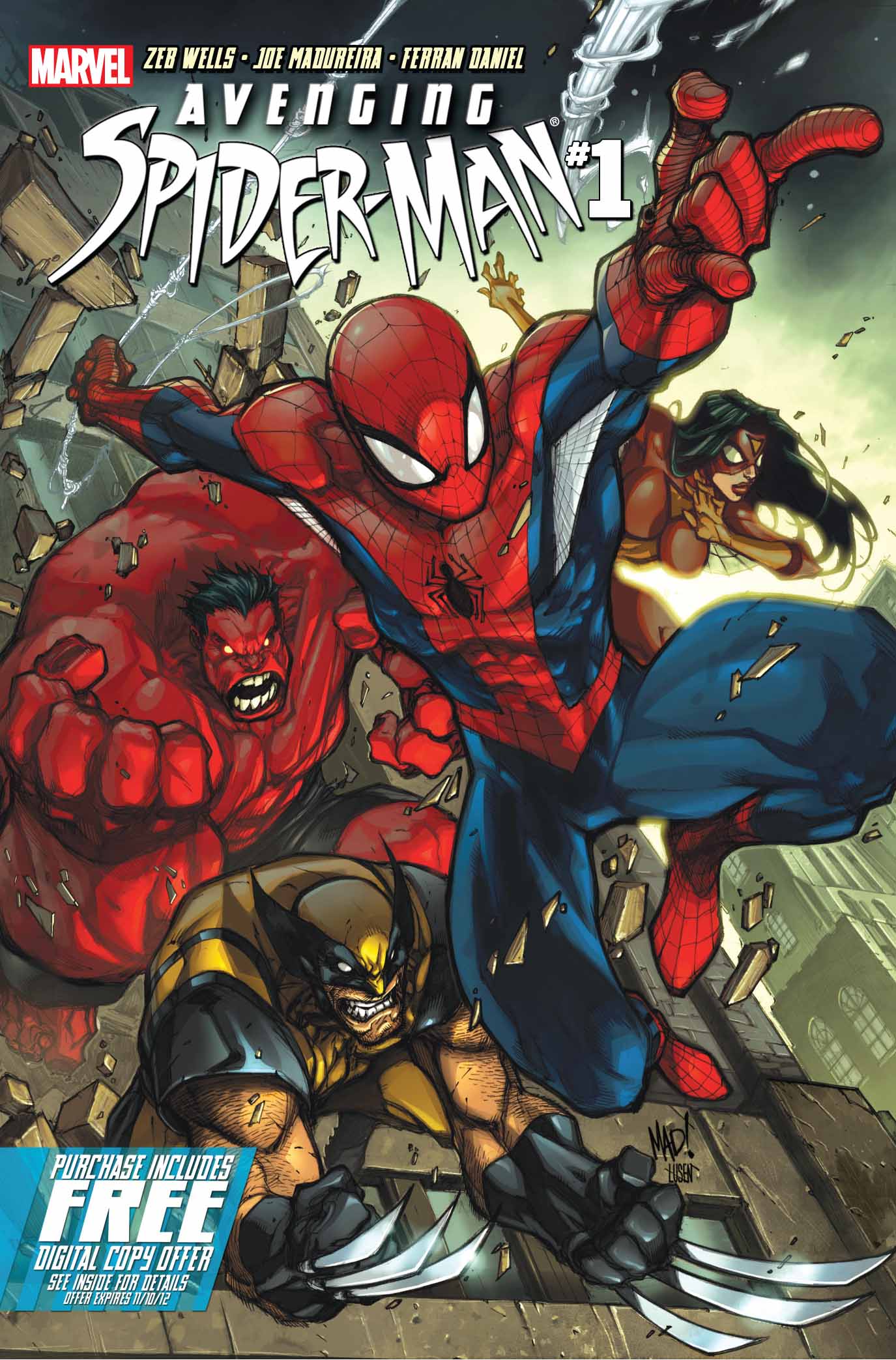
Avenging Spider-Man #1. Zeb Wells and Joe Madureira know how to do fun and funny comics. It’s good to see Joe Mad back doing comics again, with his heavily manga inspired pencils lending Wells’ all-out action story a vibrant visual panache. Yes, Spidey’s a popular guy, but if , like me, you don’t read his monthly series (any of them), this new team-up book is awesome and will hopefully serve as a godo intro to the wider Marvel Universe as Peter Parker battles alongside various fellow costumed adventurers.
Here, it’s the turn of Red Hulk (former enemy of Hulk, General Ross) as they finish fighting a massive robot with a few other Avengers, before Ross gives Spidey a lift back to New York, in a most humiliating fashion. Of course, they arrive just in time for an invasion by the subterranean Moloids, who kidnap New York’s new mayor (and Parker’s old boss), J. Jonah Jameson. This ish is mostly fight scenes, including Hulk destroying a flock of seagulls, and a double pager of a mass of Moloids jumping on a mass of marathon runners, so it means it’s slightly unsatisfying due to it being a quick read. Perfect for newbies though, as this ish (and assumedly, all future ones) consists of a neato intro summarising who Spidey and this new red Hulk are.
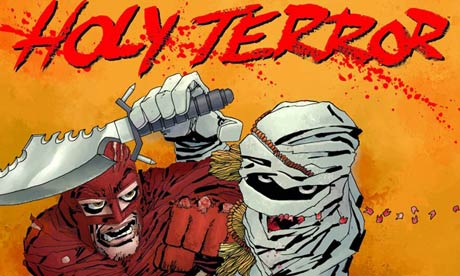
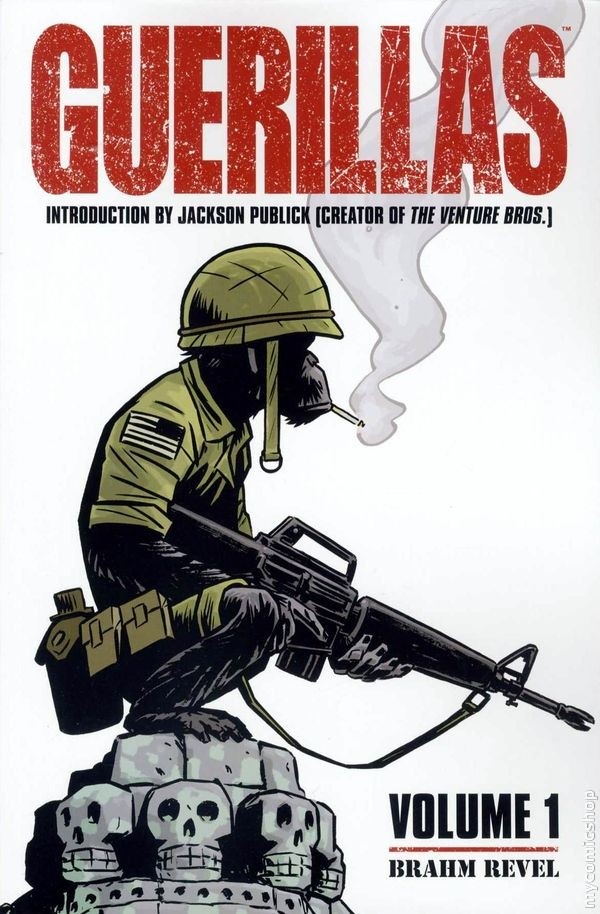
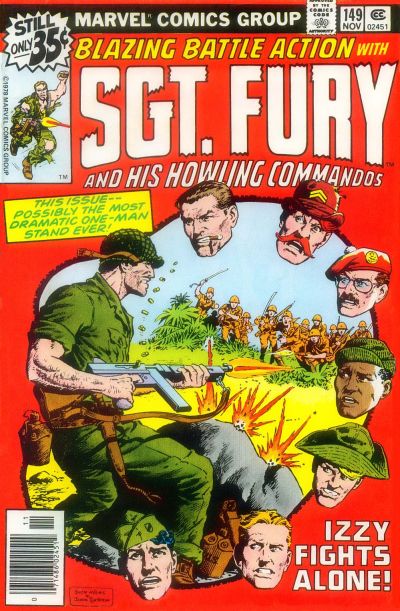
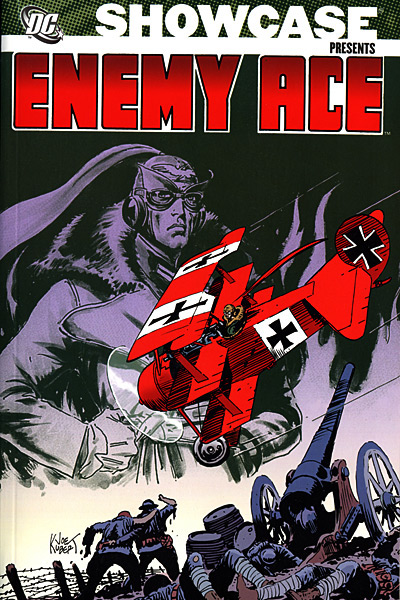
55 mins. War. What is it good for? We dive into the battlefield and how it’s been represented in comics of yesteryear and today.Plus, the wearing of shorts, head shapes and hammy thighs.
I didn’t get a chance to talk about some recent horror flicks I’ve seen on this week’s podcast, so here goes.
Scream 4. I remember being genuinely shocked at the first Scream film in 1996 and even the 2 sequels (in 1997, and 2000) weren’t bad at all. There was the feeling that no-one was safe and they were, and still are, smart slasher films. I can see the point of attempting a fourth film, as Hollywood loves a good film that can rely on nostalgia and a known series. This just didn’t do it for me though. It still felt like a ’90s film, and wasn’t as shocking, seeing as horror films have given us Saw and Hostel levels of gore in the intervening years. If they killed Neve Campbell, then I’d be shocked. The, “New Decade. New Rules” premise/tagline is a good one, but the story doesn’t live up to that potential. Oh, and Courtney Cox’s facelift just seems wrong.
The Last Exorcism was a nice surprise. A found footage film released last year it follows a disillusioned evangelical preacher/exorcist who visits a farmer’s family and meets his match. It’s a slow build, but a good one.
For other similarly scary fake doco films, check out Rec (remade in America as Quarantine), Interview with the Assassin, or one of the scariest films I’ve ever seen, Aussie film Lake Mungo.
The Ward should be avoided. Amber Heard plays a woman in a mental asylum in the ’60s and meets a few fellow inmates, who aren’t that interesting, just like the rest of this predictable film directed by John Carpenter (The Thing, Halloween). It tries to be a suspenseful horror film with a twist, but it’s really none of those things.













 comicbookjesus