Iron Man 2 Review

Every pop culture aficionado knows that comic book adaptations rarely make good sequels. Both Spider-Man 2 and Superman II dealt with heroes examining their costumed roles and giving up crime fighting and the genre seems filled with blander efforts when a “2” is stamped on the title. Really, sequels should be far superior; with the origin out of the way there’s more possibilities for greater action and drama. The Empire Strikes Back and Star Trek II: The Wrath of Khan. Now, that’s how you make a sequel.

Okay then, so where does Iron Man 2 go wrong? Needless to say, SPOILERS AHOY!
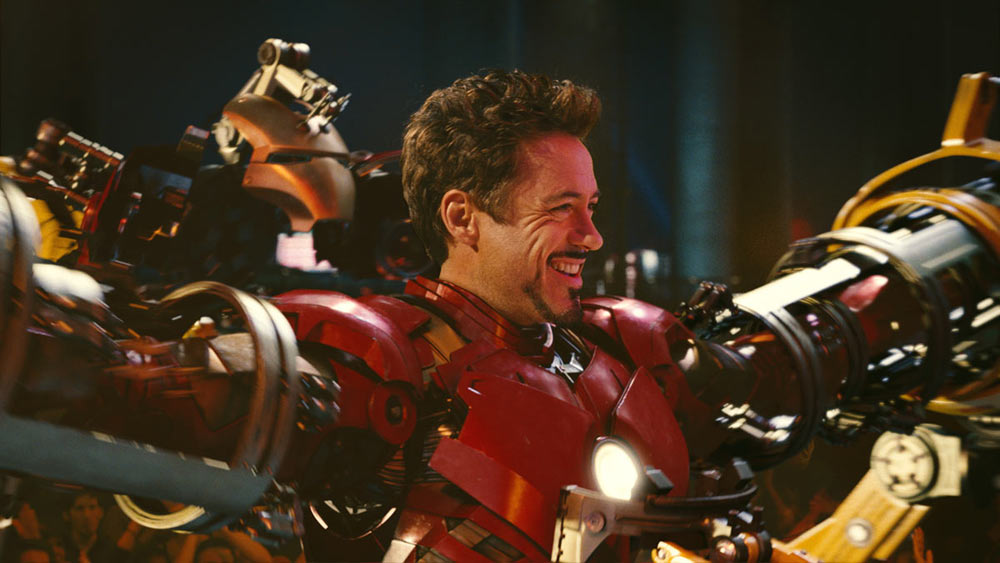
Firstly, the film starts with Tony Stark’s voice-over from the last few minutes of 2008’s predecessor and then immediately stumbles with a lengthy scene in which Tony is being questioned by  a parliamentary committee who see his Iron Man armour as a weapon dangerous to national security. This is fine, and Downey Jr. as always is charm in a sharp suit, but to begin the year’s most anticipated film like an episode of any dull courtroom TV show is  a huge mistake. It goes on far too long, there’s no introduction of the character and his world for those who missed the first film and it’s followed by an even more boring scene. Yep, Mickey Rourke in tattoos and shadows building his own dirty suit. We saw Tony do the very same thing in a cave in the first film, but the low-tech vs hi-tech approach is never realised. One could assume that this seen-it-before intro of the villain would be expanded on later, but I’m afraid not. It could’ve been an awesome chance to show the differences between golden boy Stark and his privileged upbringing with Rourke, playing Ivan Vanko (a combo of comics’ baddies Whiplash and Crimson Dynamo) but again such heights are not only never reached, but also avoided. All we know is that Vanko’s Dad helped Stark’s Dad decades ago and never got the credit, so now Vanko goes on a Stark-centred rampage. Again, Rourke play him well and looks like a combination of an Oz character who fell into the wardrobe from Pirates of the Caribbean, but as is the problem with superhero films sometimes – another villain gets in the way. Justin Hammer is a jealous Stark rival and equips Vanko with what he needs (including a parrot) to pull Stark down a peg or two. Sam Rockwell layers Hammer with the same bravado that Stark has, but with less self-confidence and greedier motivations.

Any scene between Downey Jr and Gwyneth Paltrow as Pepper Potts is sparkling and director Jon Favreau fulfills his beefier role as driver happy Hogan with gusto. There aren’t constant references to next year’s Captain America film, and 2012’s The Avengers, but fanboys and girls know them when they see them. There’s a handy list of easter eggs in the film here. I knew references to events in New Mexico were related to Thor’s hammer landing there (wait for that scene after the end credits, like the Nick Fury cameo in film one). I know many would’ve been like me and expecting Cap’s shield to be in the box Tony receives from S.H.I.E.L.D director Fury (Samuel L. Jackson) and we do see a possible prototype of it.

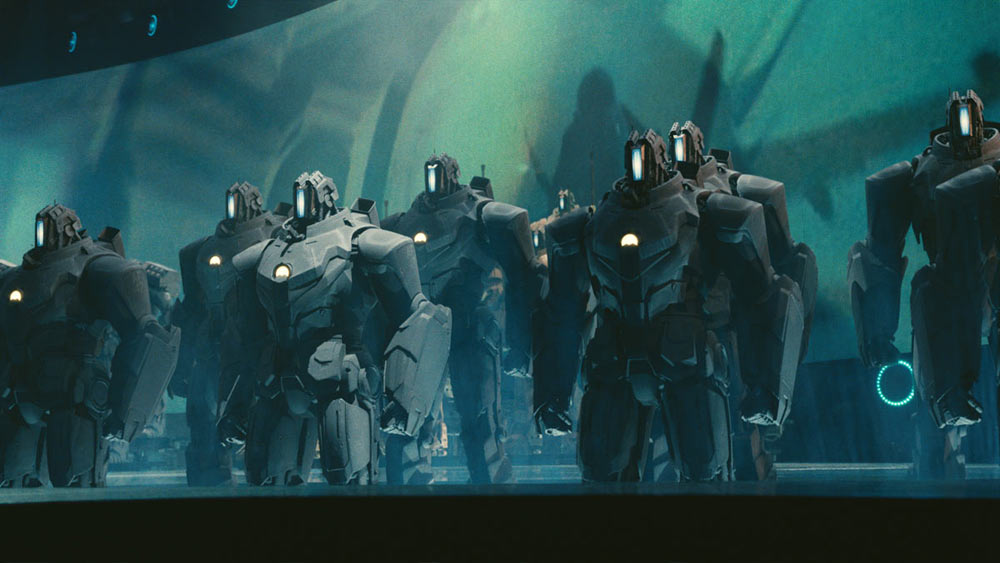
It’s great to see War Machine and Black Widow, but strangely those characters aren’t even referred to by those names. The action is fine, the SFX are great but what’s really annoying is the missed opportunities. If they dropped Hammer and focused on Vanko and Stark’s relationships with their respective fathers, and did more with Tony’s drunkeness and poisoning from the arc reactor in his chest the drama would’ve been more intriguing. Tony’s slow death, until a rescue by Fury, should’ve been at the heart of the film, but it was bypassed to show more drone designs.

It’s not a bad film, but sadly not as good as 2008’s surprise hit. Half the people in my cinema stayed until after the closing credits and there were many excited whispers as to Mjolnir’s owner, so that’s a good thing. Creating the first movie universe will at least hint at what’s going on in today’s comics. On that note, if you want a good Iron Man fix this week, grab Invincible Iron Man #25 by Matt Fraction and Salvador Larocca. It’s a double sized issue and features movie-friendly concepts such as Pepper Potts as C.E.O of Stark’s company, Hammer’s relatives, military drama and a hulking suit variant known as Detroit Steel.
Aladdin: Legacy of the Lost #3 Review

It’s no secret that I’m a fan of Radical’s luscious books, as is anyone who looks at them really, and with the good news that a new volume of Steve Pugh’s excellent Hotwire lands in July, I’m a happy man indeed.

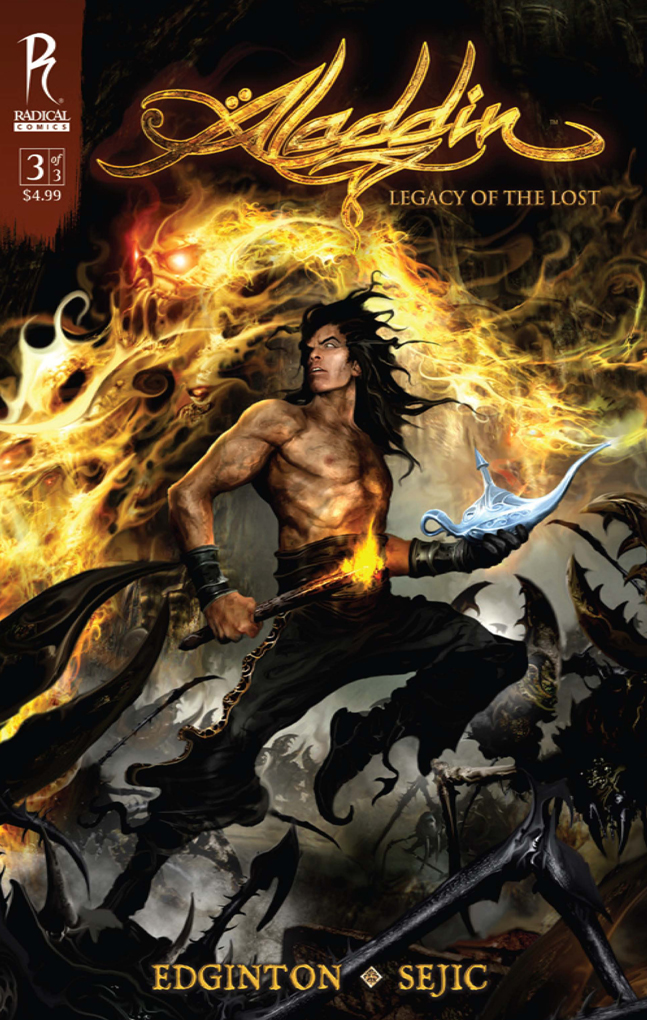
And on that note, Aladdin #3 concludes another great, and great looking, entry in Radical’s line up. Written by Ian Edginton with art by Stjepan Sejic, this has been a well crafted tale. It’s the kind of series that doesn’t demand attention, in that it’s not a high concept book (like Radical’s The Last Days of American Crime) and it doesn’t resort to cheap storytelling tricks and ‘mature’ updates of a myth to generate readers. It’s simply an attractive and accessible well structured story and unfortunately that’s all too are these days.

This final issue concludes the previous two (umm..obviously) but its simplicity means that every issue can be dove into without trying to rack your brain regarding what happened in the last installment. However, for those new to this title – Aladdin is a bit of a no hoper and a thief when he discovers a magical ring, meets wise adventurer Sinbad, tries to rescue Princess Soraya from the evil wizard Qassim and finally journeys to the undreground city where he and Sinbad get betrayed by the Mantis Queen. Kind of like Star Wars in the Middle East, but not really.

Edginton has used the familiarity of the legend including the titular hero, and wish granting djinn as the first steps on a grander epic. Throwing in surprises such as the appearance of Sinbad is just a nice bonus. The attack on Sinbad’s ship opens the issue, as Aladdin gets eventual aid from the djinn in his magical ring, who has a connection to the other djinn…the one in the lamp from the first issue, which is now held by Qassim’s greedy fingers.

Where this issue differs from the previous issues is its more hectic (though never harried) pace, the introduction of a few more scary beasts, the greater use of magic and the examples of love, and the heroism or selfishness it brings.

Sejic shines as always, quite literally, with his landscapes and dazzling cities looking like they belong in a Prince of Persia film as if made by Peter Jackson. He’s one of the industry’s brightest and most consistent artists and his sense of design when it comes to characters and layouts, holds immense visual appeal.

The other thing I noticed with this issue was Edginton’s approach to dialogue. With an ancient-set story like this it could easily become a bad mix of Shakesperean talk via the mouth of Thor, but thankfully there’s nothing like that here. It somehow feels old and I don’t mean because there’s no iPhone references. Every character speaks with the kind of purpose and heroism, and villainy, that you’d expect and want from a Middle Eastern epic journey.

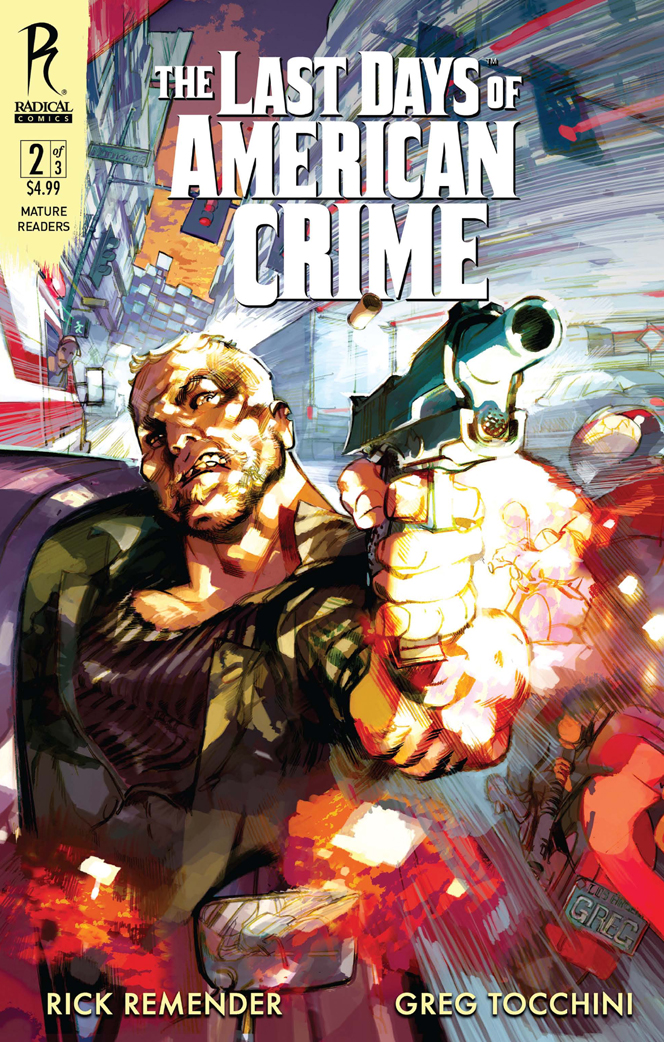
The Last Days of American Crime #2 Review

In the age of Tarantino and Ritchie it’s unsurprising that this series was picked up, by producer/actor Sam Worthington, with such immediacy. With new concepts like this, Radical show that they know what it takes to make comics like the best examples of bold cinema.

The debut issue of this bi-monthly series introduced us to the world of ageing Graham Bricke who, like many others, wants to choke every opportunity they can before the U.S government broadcasts a signal throughout the nation, rendering criminal desires null and void. It’s one of those simple concepts that can be described in a sentence, yet whose potential is limitless. No wonder Hollywood are keen. Writer Rick Remender never gets bogged down by the hug scope of the idea though. There’s hints to actions outside of the happenings involving Bricke and his fellow crims, but it’s the ragtag bunch of ne’er-do-wells who are the charismatic centrepiece. The signal combined with the complete and total transfer of paper money to digital transactions ensure that the window of opportunity for Bricke and co. is becoming narrower and deadlier.

Issue 2 begins, with only 7 days left so Bricke (or Rory as he’s also known) has to move things along quickly with his new partners, safe cracker Kevin and his hacker girlfriend Shelby (who Bricke had a brief …encounter with last issue). The 3 characters are largely separated during the story, which means with only one issue left in this series, the finale is set up to be explode.

There’s no doubt that the world of American Crime is a filthy one. Rick Remender is writing the Punisher after all, so he knows a thing or two about the criminal mind, but whereas his work on that series, and Fear Agent shows a deft ability to welcome the fantastic, here he has a different agenda. From the opening pages in which members of a Mexican gang threaten a rival’s naked partner, it’s blindingly obvious that this isn’t one for the kids. Remender knows his boundaries though. There’s never a point, despite all the profanity and loose morals, that he’s puffing his chest out to show how ‘cool’ he is. He shows restraint and makes sure to give the reader a breather, and that’s something that Mark Millar could do with learning. There is a lot more violence, nudity and drug use in this issue than the debut, but there’s also the sense that Remender is ramping up his grandiose story, with the reason to the signal being given, as well as its implications on society’s freedoms.

This is a well paced tale, with Bricke as the guiding force, but the scenes involving Kevin’s run-in with some local drug dealers, his visit to his unique and wealthy family, and Shelby’s kidnapping, (along with the possibility of backstabbing) means that this is a guaranteed page turner. With a world filled with hardcore characters in the Sin City realm, and the approach of a Hollywood blockbuster, American Crime is an intoxicating, if sometimes shocking, mix.

A large part of the razzle dazzle is due to Greg Tocchini’s sizzling artwork. I’ve never seen an artist who can colour his own pencils with such verve. He has a rough approach, but one that is filled with details lesser artists wouldn’t bother with. By choosing unique angles it really does feel like a movie directed by the next big thing from the world of music videos.

This is another great entry in this series, and for a cheap 64 pager with a production and design gallery included, it’s pretty hard to pass by.

Resistance Book 1 Review

At Broken Frontier is my review of the OGN, Resistance from First Second Books. It’s a fairly solid drama about a group of kids joining the French Resistance during the dangerous days of WWII. Read my full review here.

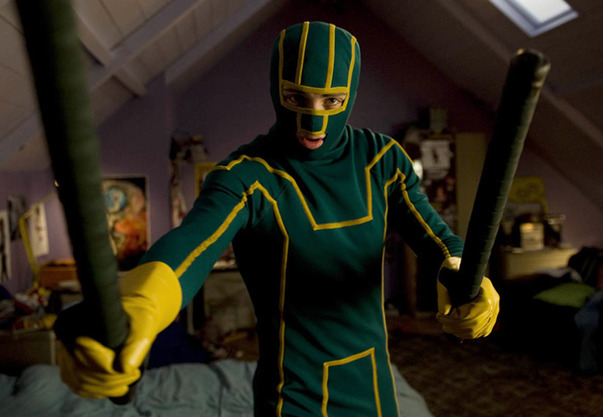
Kick-Ass Review

I won’t necessarily say that I can’t see what all the fuss is about, because I can understand how seeing a pre-pubescent girl wielding a samurai sword, and a variety of guns while swearing can be jarring. However, I’ve read all the issues of the comic and it’s a lot more in your face on the page. What is sorely lacking from the transition to celluloid is the dark humour, and the likeable aspects of protagonist and titular vigilante Dave Lizewski.

It’s certainly a fanboy film, and comic creators Mark Millar and John Romita Jr, and film director Matthew Vaughan (Layer Cake) know their target audience well. From the Superman-like intro credits to the many scenes set in Atomic Comics, it is an experience for comic readers who can embrace the silly aspects of the superhero, with Nic Cage doing his best Adam West Batman impression, and Kick Ass hitting the streets in a green wetsuit. What is missing is the sense of fun, which does arrive too late at the film’s emotional and satisfying climax. Aaron Johnson is a fine actor, but he’s overshadowed in his own film, by baddie Mark Strong, Chloe Moretz as Hit Girl and Christopher Mintz-Plasse as the fumbling Red Mist. It’s not long into the film that Kick Ass deviates from the source material (particualarly in who dies and who lives) but with only 8 issues released in 2 years, the film makers had a lot of room to move.

It is an enjoyable film, but not as ‘out there’ as I expected. There’s no nudity or excessive swearing or intestine spilling. And that’s certainly a good thing. Any Tarantino film pushes the envelope more than this in respect to blood letting. Raising issues of family, friendship and standing up for your fellow man may get lost in all the gaudy costumes and gunplay, but don’t dismiss this film straight away. It’s not another great cross-over film with daring and artistic mass appeal like say, Sin City was, but at the same time, it does stand out more as a parody amongst the horde of comics films that have landed on cinema screens in the last few years and proves that even sequential art can be self referential rather than self reverential.

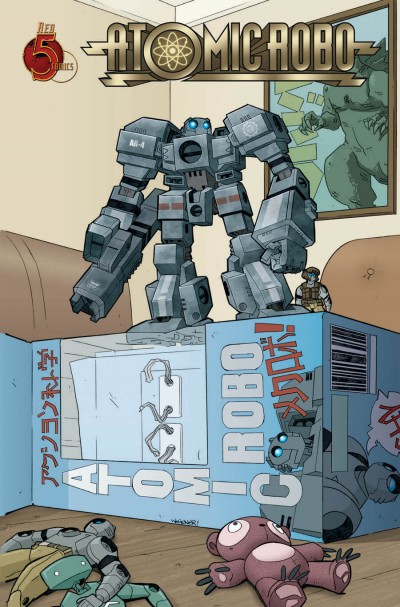
Atomic Robo #4.2 Review

It’s about time the Atomic Robo writer got some grander opportunities. Of course, everyone and their grandma loves Robo for its refreshing mix of humour and action in a very aware pop culture package. It’s the kind of quirkiness that geeks like me find irresistible. Now, Brian Clevinger is writing an all-ages mini focused on The Infinity Gauntlet saga for Marvel. Nice one.

So, back to Robo. The old robot adventurer is really Red 5’s flagship character, as he should be. Instead of an ongoing series, Clevinger and artist Scott Wegener have wisely chosen to create a series of mini-series, of which this is the fourth, with the subtitle Atomic Robo and the Revenge of the Vampire Dimension. Last month’s first issue had Robo interviewing two candidates for an Action Scientist position, filled with the usual great dialogue such as:

Bernard: What were you doing in a volcano?

Robo: Action geology.

and an attack on Tesladyne Industries’ base by the titular “vampires.” This second issue (set in 1999) is fittingly titled Big in Japan, in which Robo meets Japan’s version of  his team, the Science Team Super Five! It’s not long after the introductions that a few nasties invade Tokyo Bay and the Science Team must go out on their first real mission with all the energy, dramatic posing and primary coloured costume wearing of the Power Rangers parody that they are. Then a rather…crabby former colleague of the Science Team’s leader shows his face and Robo comes to the rescue.

With a subtle Star Wars reference, a Mecha Robo and photocopiers as weapons, this is yet another winner in this series. It’s not as funny as previous entries, but there’s still two more issues to go (and presumably more of the vampires, as they don’t show up here). Wegener’s timing and spot on expressions are chuckle worthy as always. He and Clevinger really are a great duo, with an eye on reliable fun at all times, and show yet again that Robo is a witty and accessible series; the kind of book that both jaded fanboys and comic book newbies need.

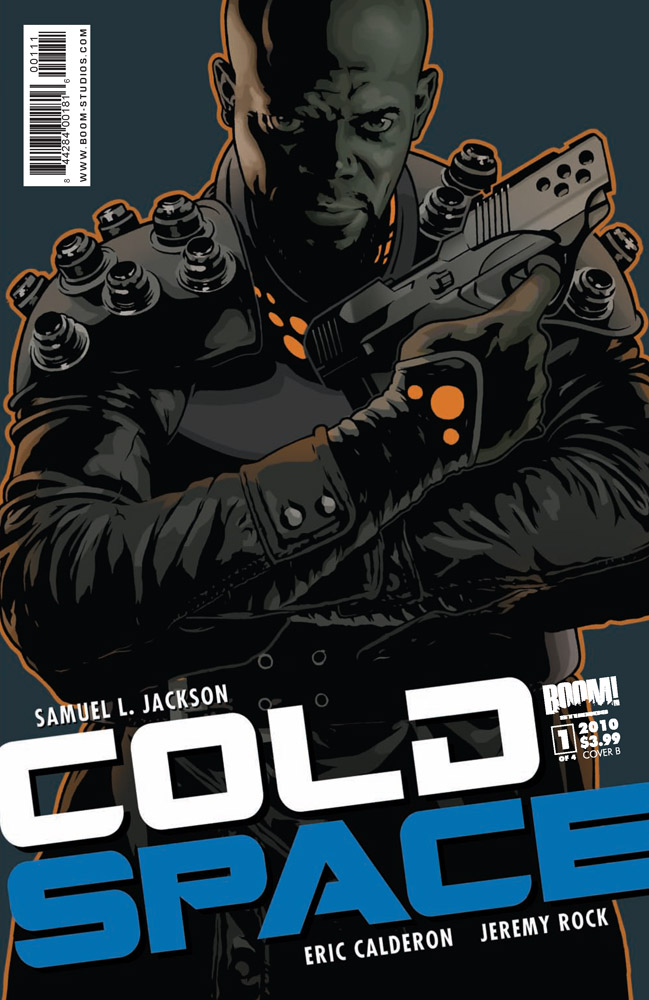
Cold Space #1 Review

Justifiably, fanboys and girls often glance sideways with when they see a celebrity’s name stamped boldy on a cover in their LCS. Lately, actors and musos have flocked to create, or sometimes, “create” comics in ways they never have before, and you can’t blame their timing, or the publishers who want to capitalise on their pre-assembled audience. It is a business after all.

These celebrities aren’t always particularly aware of modern comics, and sometimes it seems they lend nothing more than their name for some geek cred, but the last fortnight has seen two honest to goodness celebrinerds step up to the plate. UK talk show host Jonathan Ross, aka Wossy, released Turf last week from Image Comics. I must say it was a relief to see the “Created and written by” credit and know that it wasn’t mere hyperbole. As fellow writer Mark Millar explains in his afterword, Ross is a real fan of comics who knows his stuff and isn’t afraid to use his fame as a platform to share the inherent greatness of sequential art. Turf #1, with fitting art by Tommy Lee Edwards, is more wordy than a Bendis script, but its tale of old school gangsters in the age of Prohibition, with a smattering of vamps and aliens, is a worthy debut.

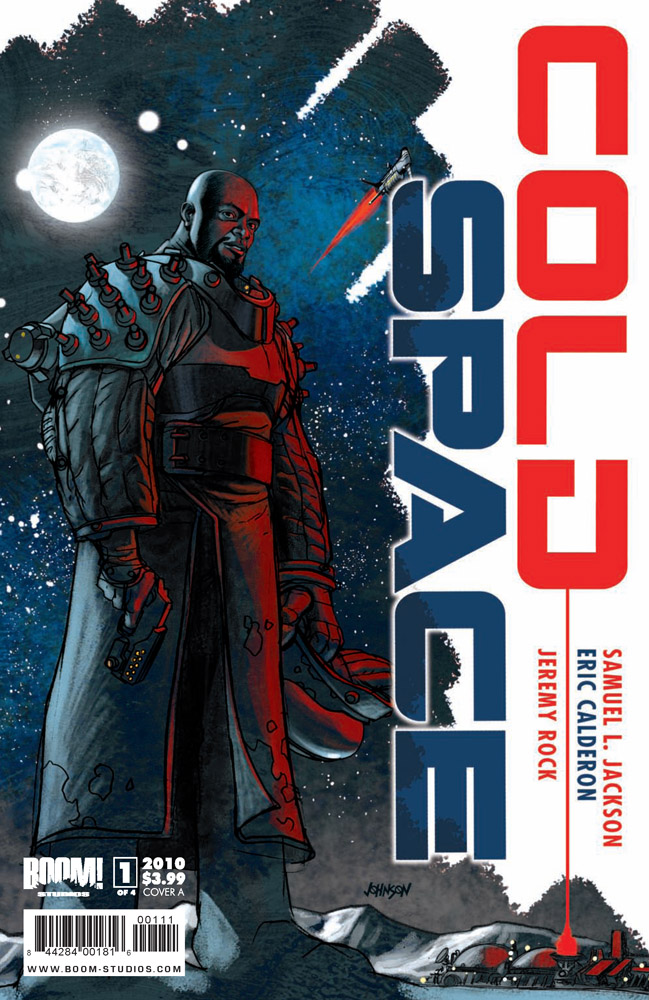
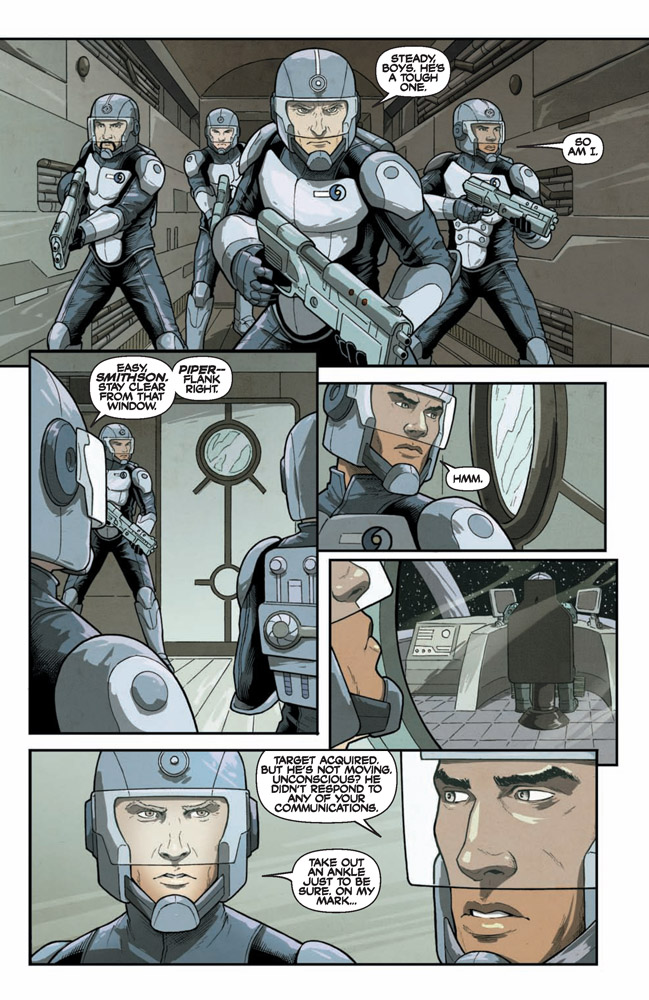
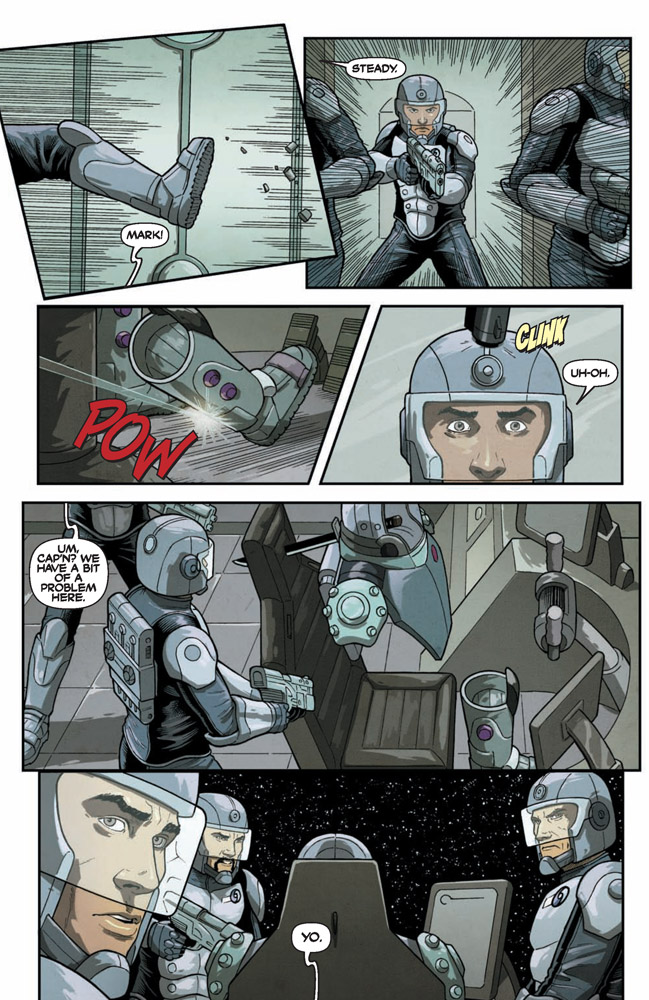
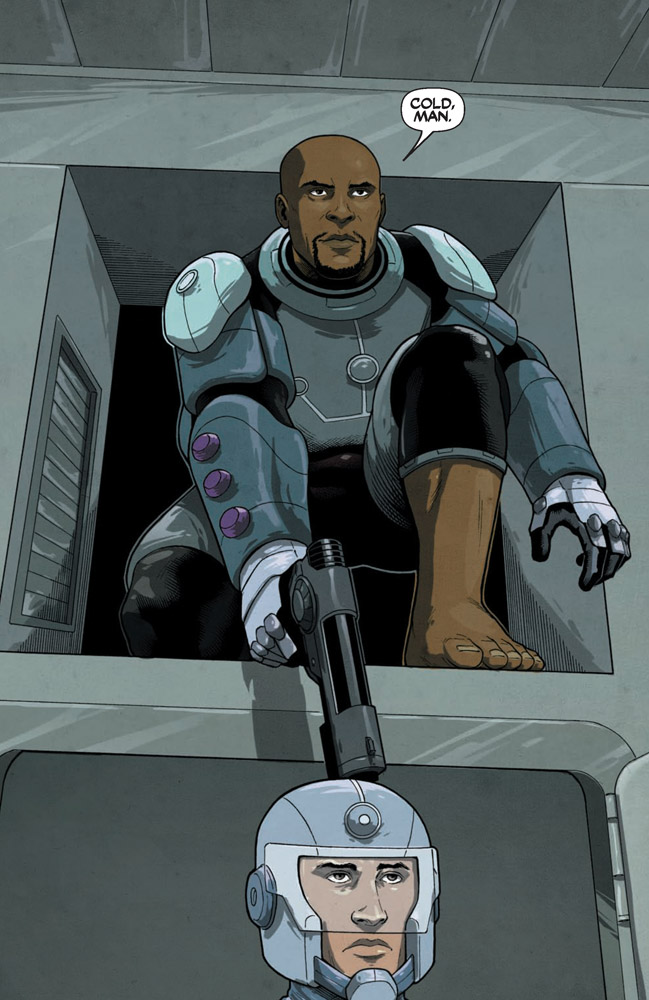
Now, we’re spoiled with Cold Space #1 from the ambitious BOOM! Studios. C0-created and written by actor Samuel L. Jackson, he probably had less to do with this output than Ross had with his vision, but at least we know Jackson has comic book cred too. Perhaps he’s not in the exact same boat as Ross, but he’s ceratinly in the same river. Jackson has appeared in The Spirit and Iron Man, and the Ultimate version of Nick Fury is based on him. Cold Space is created by Jackson and Eric Calderon, the same duo responsible for the animated series Afro Samurai. So, it’s off to a good start then.

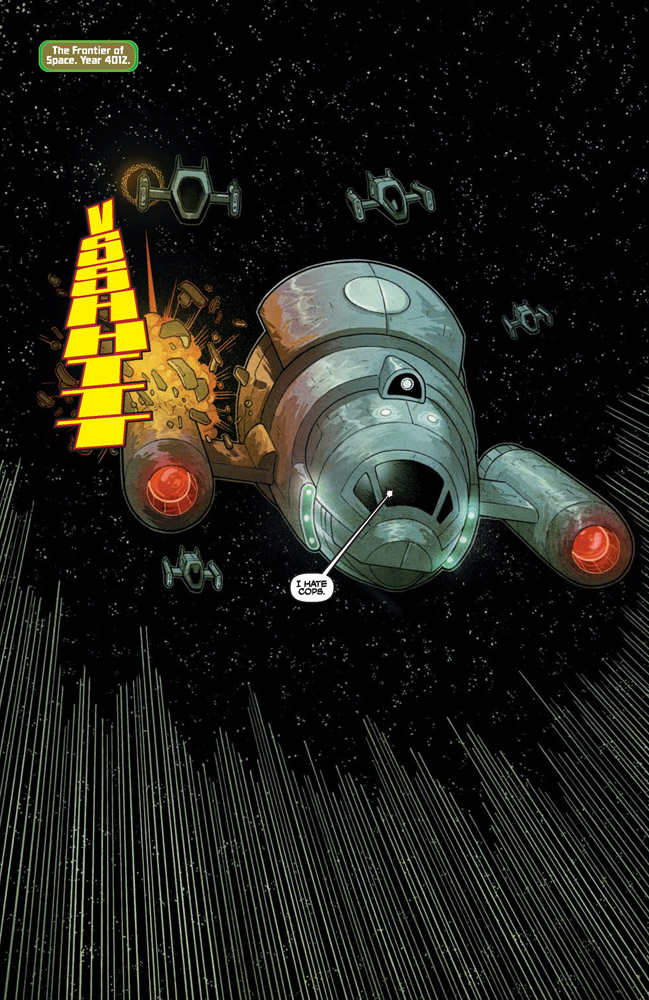
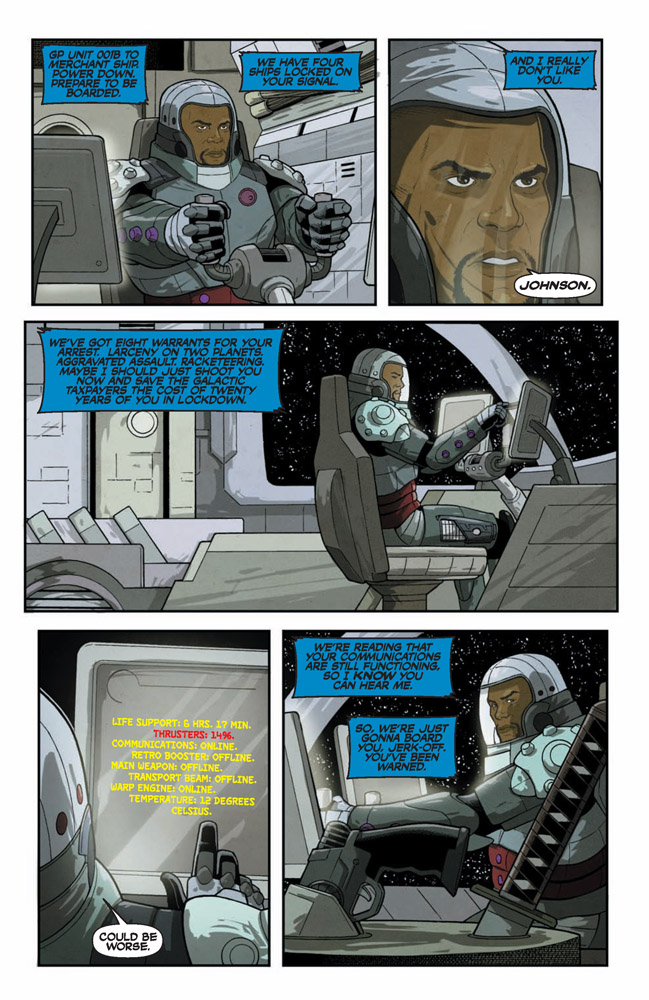
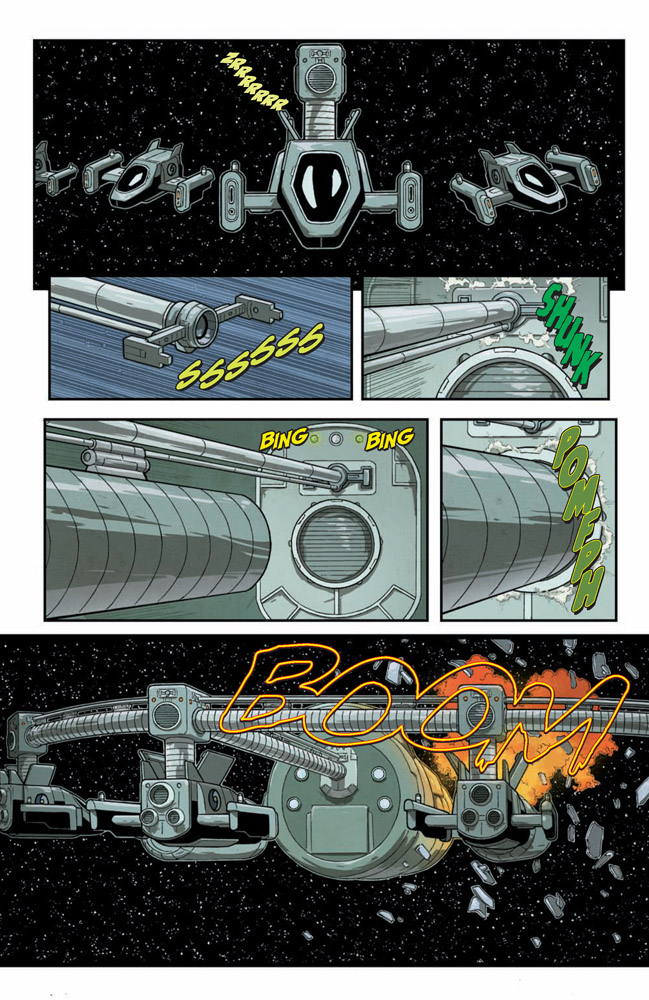
The background of Cold Space is not a far off world, so to speak. There’s no talking robots and exotic alien races, so far. It begins with Mulberry’s (Jackson’s comics doppelganger) ship fleeing four enemies in the year 4012,  before being boarded by cops he’s obviously dealt with before. After some swift moves, and swifter talk, Mulberry gives the aggravated officers the (pardon the pun) shaft, and leaves with a smirk on his face. However, that doesn’t last long, as Mulberry’s stolen ship explodes and crashes on a planet filled with Wild West-like lowlifes.

From the solicitation info it’s clear that Mulberry soon becomes caught in the middle of a civil war on the small mining town he’s stuck on, and rather than choosing sides, he chooses to make a profit. That’s an interesting premise, but one that doesn’t get revealed in this first issue. We are introduced to Mario Ward (who reminds me of Lenny form Motorhead) and his crew, and are given glimpses of the other gangs in this desolate place, but that’s about it for now. This has a great beginning, (even if it takes a page or two to realise the text boxes aren’t captions, but rather off-panel dialogue) with its succinct action filled introduction of Mulberry, and I do want to see more of him. There’s no real surprises here, but I have a feeling the true ‘meat’ of the story is yet to come. It’s a great entry point for comics newbies and Jeremy Rock’s crisp approach to art is reflected in its accessible story structure. How Mulberry interacts with the dodgy residents of El Matador, yet still remains a sympathetic main character, will be interesting to see.

Rock’s visuals are clean and though there’s no Bryan Hitch level of realism, the look of Jackson still shines through Mulberry’s appearance, and even his speech at times. The costume and character design is varied, making the cast easily recognisable, and they obviously have great tailors and dry-cleaners as they look immaculate for a community inhabiting a dusty mining town. I wasn’t expecting an almost cartoon approach to the look of this series, knowing its starting point of Jackson as a sci-fi criminal, but the lack of harsh language and bloodletting is actually quite refreshing, and will hopefully encourage older kids, as well as curious fanboys, to give this series the look it deserves.


The Light #1 Review

On sale April 14 is this excellent debut from Image. Written by scribe on the rise, Nathan Edmondson (the equally excellent Olympus) and art by the always dependable Brett Weldele (The Surrogates) this is a hard to resist welcome to a new 5 issue mini-series. The Light is bookended with an excerpt from a poem by Alfred Noyes and an afterword by Edmondson in which he ruminates on the engulfing rise of technology and interconnectivity. As the characters in this issue discover, “there is no escape from it.”

Edmondson wisely reveals very little, and dramatically kicks things off straight away. It’s a daring choice, but also one that makes perfect sense. I can’t imagine anyone picking up this first issue who won’t want to see what happens in the months to come. This is a comic written with intelligence and restraint. There’s no time to take a breath and catch up on exposition here.

It begins with middle-aged welder Coyle losing his job. It’s not soon before you realise that this “hero” is also a wife beater and alcoholic, as he returns home to his daughter (who he’s raising with his mother’s help) who he wants to avoid and the next bottle that he wants to befriend. So, not your typical protagonist, but mere moments later Coyle must man up. He wakes up in the early hours to his neighbour running down the street screaming to not look into the light. We soon discover, with Coyle, that “the light” is not a particular orb of incandescence hovering in the sky, but a much more dangerous threat – all light.

Putting on his welding goggles, and waking his disbelieving (though not for long) daughter Avery, he blindfolds her and leads her through suburban streets of chaos as those that do indeed look into lamp posts and light bulbs spontaneously combust with some sort of electrical discharge. It’s a no hold barred introduction to a new story, and one with a hectic pace.

Weldele’s art is absolutely perfect for this. It fits into Edmondson’s tale wonderfully. His moody, subtle renderings and contrast of light and dark  put an extra urgency onto these pages. It’s hard to imagine anyone interpreting this unique concept with greater visual flair. For those who may have found his minimalist approach to sci-fi in The Surrogates jarring, you’ll be much more welcoming here, as he shows that even suburban streets can be creepy.

Whether this is a national, or global outbreak is yet to be seen. There are no answers here, only confusion and fear, which puts the reader right in the running shoes of the survivors. From what seemed like a concept almost too simple (“Light as a killer?” Really?”) The Light will quickly erase any doubts with its crisp storytelling and horror premise.

Rough Justice Review

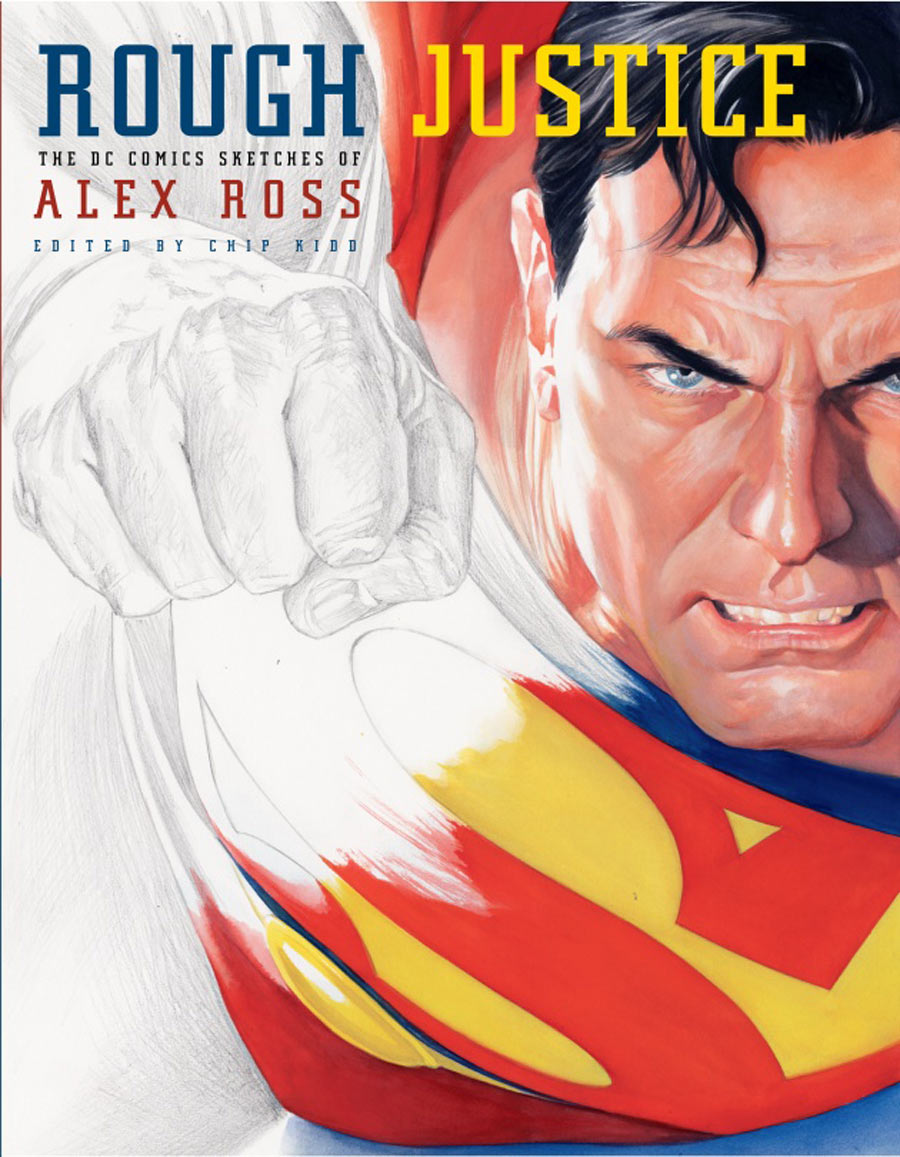
I’m getting into art books lately, and there’s quite a few coming out in the next few months, including those focused on Adam Hughes and Jim Lee. Staying in the DC family is this handsome collection, with the full title of Rough Justice: The DC Comics Sketches of Alex Ross. The American painter has carved out a niche for himself over the last 2 decades with his realistic work portraying the power and dynamism of spandex clad icons. DC has been blessed with the majority of his output, with covers for Superman and Batman, as well as series such as the future-set Kingdom Come and nostalgia-laden Justice. It’s the latter which takes the bulk of these 224 pages, but there’s plenty of other pieces for the Ross fan, or simply those who like staring at great art. That’s the beauty of Ross’ work. It shatters the confines of the comic shop. I took this dazzling tome to work today and the few people I showed it too were almost drooling.

Designer Chip Kidd who has worked with Ross before on his similar Mythology book here guides the layouts and appearance of the content. It may be tempting to think that he doesn’t have much to do as Ross’ work speaks, or shouts like Brian Blessed, for itself. However, after a few reads (you won’t be satisfied with just one) you’ll realise that the variety is a key part of the book. Going with the “rough” theme, you won’t find many of Ross’ trademark glossy paintings, but what you will find is a treasure trove of character sketches, draft cover layouts, action figure designs and costume re-designs. It’s that latter aspect of Rough Justice that long-time DC fans will find most appealing.

Before All-Star Batman and Robin became what it was (insert joke here) Ross went to artist Jim Lee with his new Robin design, involving a hooded cape and scale armour, a la Aquaman and Captain America. Martian Manhunter looking like a tentacled Spectre, a sleek Atom, Nightwing and Flamebird from Return to Krypton and other rejected character re-designs, including Dick Grayson as Batman, are presented here. Ross’ passion for the Marvel Family shows in a series of great art pieces for a 2005 proposal for new Shazam adventures, which surprisingly yet fittingly involved Black Vulcan from the 1970s Super Friends cartoon.

Kingdom Come, Justice Society, logos, posters, TPB covers and more are also highlighted, as are a proposal entitled Batboy, Grant Morrison as Brainiac and brief comments from the man himself. Really, Ross’ pencils are so tight they they can’t really be called sketches, and any page in here could proudly hang on a wall.

Rough Justice is available now from Pantheon, and there’s a brief interview with Ross over at CBR here.

A Few Quick Movie Reviews

The Box. A return to form for writer/director Richard Kelly (Donnie Darko) after the misguided project that was Southland Tales. The Box stars James Marsden and Cameron Diaz (both of whom have appeared in comics films – X-Men and The Mask respectively) as a couple in 1970s suburbia who receive a simple box from the mysterious Mr. Steward. They push the button in the box and get $1 000,000. Oh, but an unknown person dies too. Let the morality debate begin! It’s a well-made drama, especially in the first half, but as questions receive answers (involving lightning, water portals and NASA conspiracies with an alien life form) it becomes less engaging. The acting is top notch and Kelly crafts the film with restraint. Props must go to him to managing to make a good (mostly) film from a short story by Richard Matheson (I Am Legend). With elements of a creepy thriller and an emotional core centred in Diaz and Marsden, it does have its high points. Don’t expect a feel good film though.

Anvil. A real life Spinal Tap is the obvious description but this film about two Canadian best friends who are desperate for success in their hard rock band is an engrossing film about dedication and holding onto dreams throughout life’s dramas. There’s also rockers attempting tele-marketing and getting paid in soup at the end of a gig. Yes, it’s often humorous and sad.

The Invention of Lying. Ricky Gervais knows he can only play one part, and does so in everything. This could’ve been a great film. The concept of a world in which no-one has ever lied, and Gervais is the man to discover the concept of not telling the truth is a grand place to start. It seems like a Monty Python sketch that was never filmed. However, right off the bat it becomes obvious that in this world people not only don’t lie, they also constantly speak their inner thoughts. Those are two different things, but there is some comedy to be found. It’s just a shame it morphs into flat drama and God bashing mid-way through. There’s also far too many scenes in which songs play throughout montages with no dialogue. It just seems like filling in time. As is the case with all of Gervais’ films, the bloopers are always worth a watch though.

Jennifer’s Body. Like the film above, this seems like a vanity project based on a writer’s previous success, whereas it should’ve had more studio guidance. Diablo Cody did a stellar job with her first screenplay in Juno, but here she tries too hard to make every line of dialogue a new catchphrase. Basically rockers sacrifice “virgin” Megan Fox, but she returns to life as a man-eater, literally. It’s not really funny, or gory, and the lesbian make out scene and constant Fox pouting just screams of desperation.

Aladdin: Legacy of the Lost #2 Review

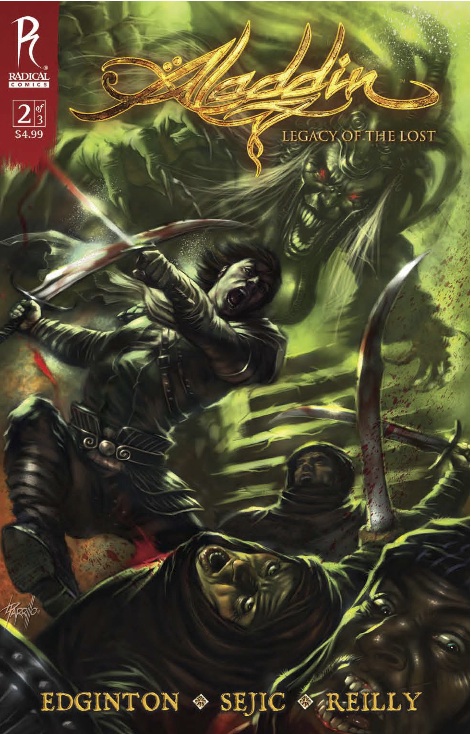
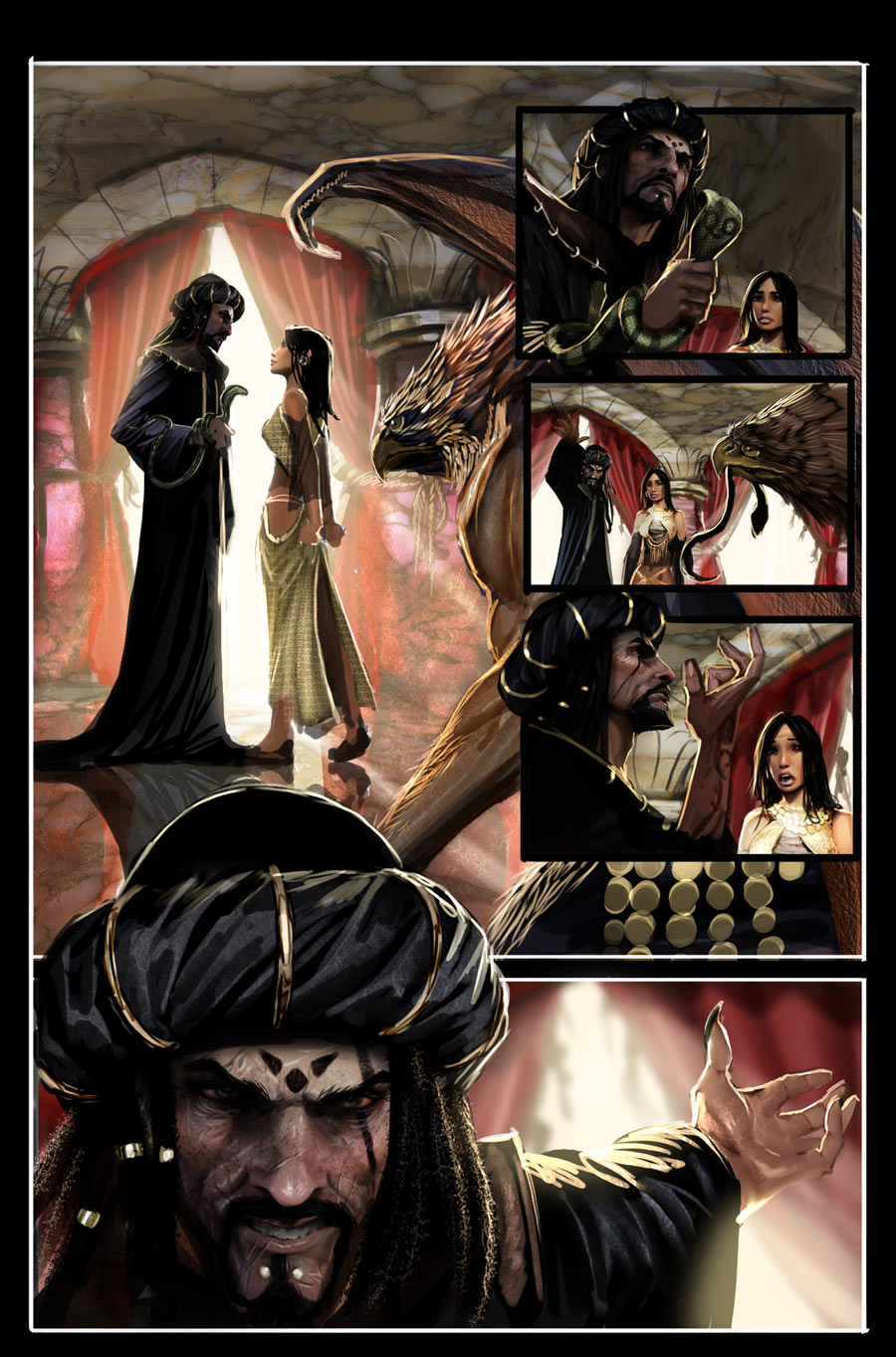
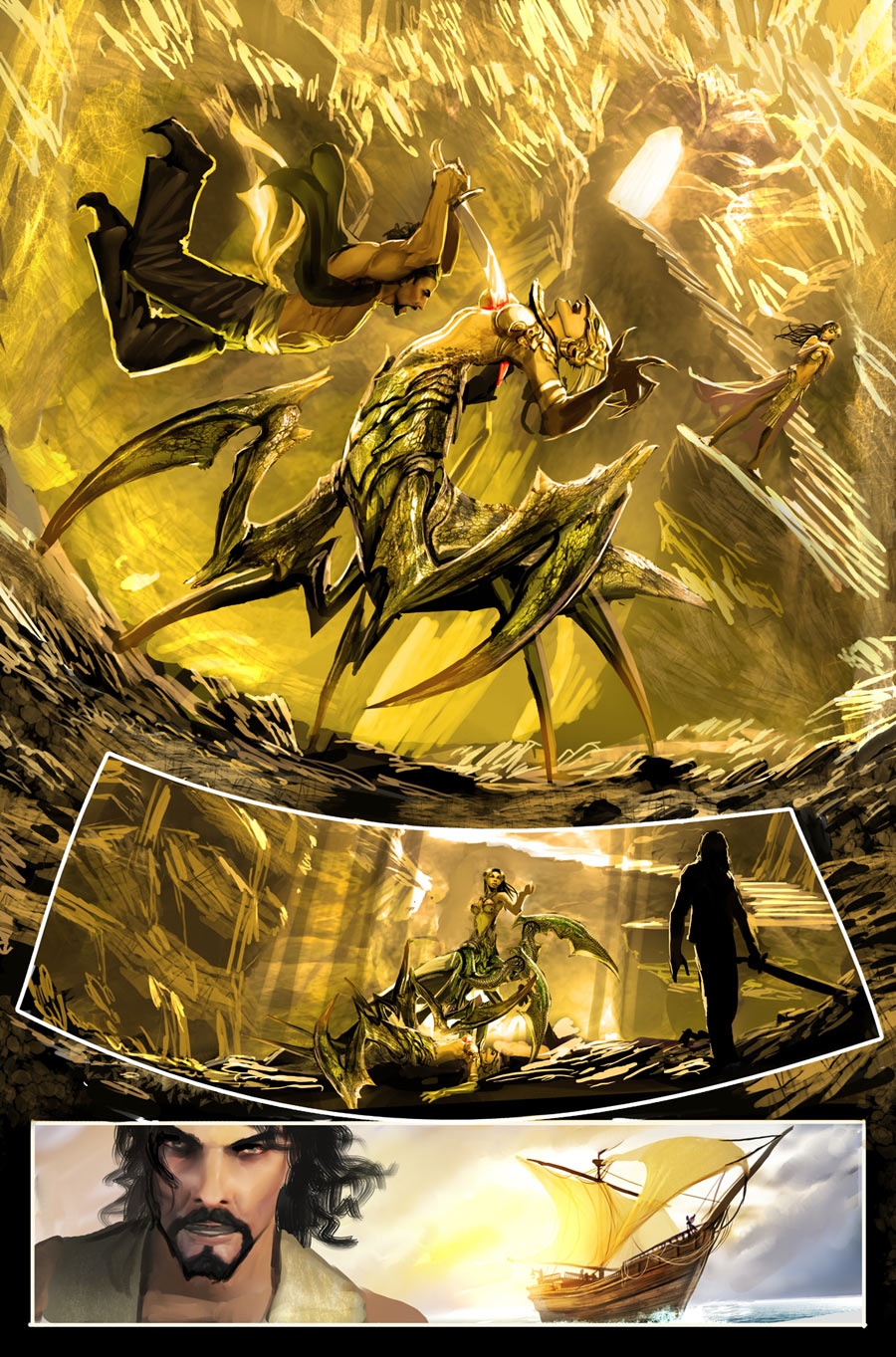
So many good looking Radical books, so little time. My review of this week’s issue of their Aladdin reinvention is up now at Broken Frontier here. Written by Ian Edginton with art duties shared by Patrick Reilly and Stjepan Sejic, this second issue is a visually dazzling adventure. To prove my point, below the cover you’ll find pics of Sejic’s pages, uncluttered by text.

Nemesis #1 Review

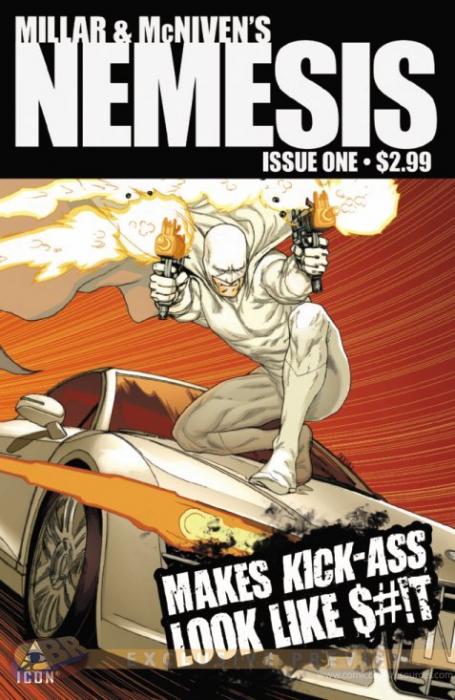
Well, Mark Millar and Steve McNiven have done it yet again. After the duo showed their artistic chemistry with Civil War and Wolverine: Old Man Logan, they whip up another series to complete the Marvel triumvirate. The obvious comparisons would be the down and dirty baddies vs goodies of The Boys with the in your face antics of Kick-Ass (also written by Scot Millar and on Marvel’s creator owned Icon imprint). Fans of either of those series will lap this up. When it was originally announed in a shroud of mystery, Millar cheekily summed up the concept as, “What if someone with Batman’s resources had the moral fibre of the Joker?”

Of course, fanboys lapped that up like hotel bookings at Comic Con. This first issue reveals very little about the titular “world’s only super-criminal.” There’s no origin, or even a name. What we do know is that, “he targets a policeman, moves into town, selects a team from the local hoods,” and causes manic destruction with the precision and planning of a Die Hard villain. The latest target of the white clad man with too much evil and time in his hands is Blake Morrow, a middle aged Chief of Police who doesn’t tolerate profanity (which means he wouldn’t read this book) or crime in his beloved city of Washington. In fact he’s decreased it by a whopping 60%.

As this debut issue opens Nemesis is holding a bloodied Tokyo cop hostage and disregards his life in a manner that defines overkill. Let’s just say there’s an exploding hotel and a falling train involved. Nemesis then decides his next challenge is to be found in America, as he considers Morrow, “a worthy opponent.”

The rest of the issue is a wise set up. Nemesis and Morrow won’t actually meet until next issue I assume. Here the pale force of destruction lands on the wing of the President’s plane, Air Force One with a gun almost as big as him, just to prove the point that no-one’s beyond his cruel reach. With such wild antics, surely Nemesis isn’t Batman by way of Joker after all. Does he actually possess superpowers? I mean the term “superhero” and “supervillain” get applied to non-powered characters too. Hopefully that will be clarified next issue. It may not seem like a big deal, but if Nemesis does possess powers, he’d be the only one who does in this world. That would be an interesting approach; if Nemesis is just wreaking havoc on the world because he can and doesn’t have an also-powered superhero to do battle with. He treats humanity as a cat would treat an injured mouse, as a killer whale would approach a seal before devouring it.

Morrow is set up as an interesting foil, but the core of his being seems summed up in a few mere sentences – Catholic, popular, family man. Got it. However this intro comes after he blows apart 5 armed robbers (none of whom have hostages) in a grocery store. It takes 5 armed men to rob a food outlet? Did they think they were walking into Fort Knox? That rash action seems at odds with Morrow’s fatherly demeanour, but then again, maybe those strong arm tactics won him that 60% crime decrease. Again, if Morrow disposes with all bad guys with the same cold manner that Nemesis uses against everybody, that conflict could be interesting, but it’s something that has yet to reveal itself.

Nemesis doesn’t scream of originality. We’ve seen all this before in any Punisher series in the last 10 years, but Millar does have a track record that requires our trust in what he’s setting up here. Like Kick-Ass there is the feeling that something special is being created and we’re in on the ground floor, before Hollywood brings it to everyone’s attention, which may just happen if Millar’s wonderfully honest afterword is anything to go by.

Steve McNiven’s art isn’t as detailed as his Civil War and Wolverine: Old Man Logan work. He’s doing his own inking here so there’s less spectacle and more simplicity. The mass destruction just doesn’t have the same visual impact it should. Nemesis’ costume is perhaps comics’ most simple yet, with just a white body suit and mask. No room for holsters, even? Perhaps he really is super if he doesn’t need a utility belt, or even room for spare ammo. However, the contrast of blood on the plain white suit, plus the use of white instead of black to represent evil, I guess was enough of an impetus to create it.

Nemesis obviously knows Morrow (even if the reverse isn’t true) and via the we’ve-seen-it-before approach of terrorising the city through a TV broadcast calls his latest attack, “revenge for a stolen childhood,” and refers to himself as, “the black sheep of the Anderson family.” Those narrative hints and the promise of more Millar/McNiven magic is more than enough for now to keep me around on this new series.

Let’s Hear It For The Girls!

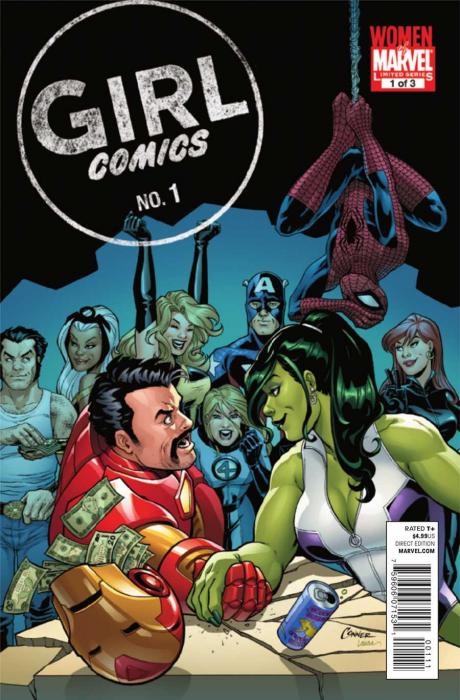
Marvel’s Girl Comics is a 3 issue mini-series created by a team of talented ladies. It’s also a good idea. Now I know every now and then a comic company will scratch their head over just how to get girls to buy comics, and from what I understand, the number is growing, particularly in manga. DC tried a noble attempt a few years ago with their Minx line, which unfortunately never took off the ground. However, there are a lot more female characters in the spotlight in the pages of both companies superhero books. In May alone Spider-Girl returns again, Dazzler gets a one-shot, as do the many loves of the Amazing Spider-Man in a book of the same name, Galacta: Daughter of Galactus hits, Black Widow’s new series continues, Emma Frost gets an origin spotlight special, and Marvel Her-oes continues with its focus on teen female Avengers. Plus let’s not forget all the female spandex wearers in the various X-Men and Avengers titles. Of course, giving more female characters series doesn’t mean more female readers, as I’m sure there’s a fair amount of appeal to both sexes with superhero stuff, but it’s a good step in the right direction.

Now, about Girl Comics. I’m a sucker for anthology books, and this appealed. Not all of the 7 short tales contained within are good, but they represent a great diversity. Most don’t feature females as leads, but are just slices of superheroes from different perspectives. Willow G. Wilson (Vertigo’s excellent Air) and Ming Doyle present a simple tale of Nightcrawler saving a perfromer in what looks like a WWII cabaret bar, Valerie D’Orazio and Nicki Cook show Punisher in a subtle, yet creepy tale of child protection and by far my favouritre – Head Space by Devin Grayson and Emma Rios (whose art I’ve loved since BOOM!’s Hexed). The other tales fall kinda flat for me, but that’s the lottery of an anthology. I’ll certainly pick up the remaining two issues, just to see what talent lies on offer. The creator biographies and and spotlights on Marvel employees Flo Steinberg and Marie Severin are a superb touch too.

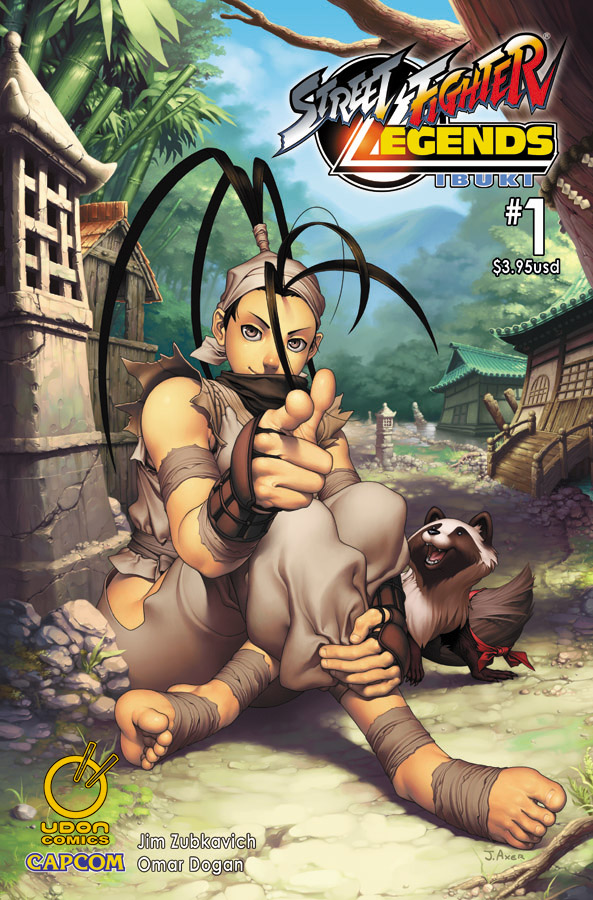
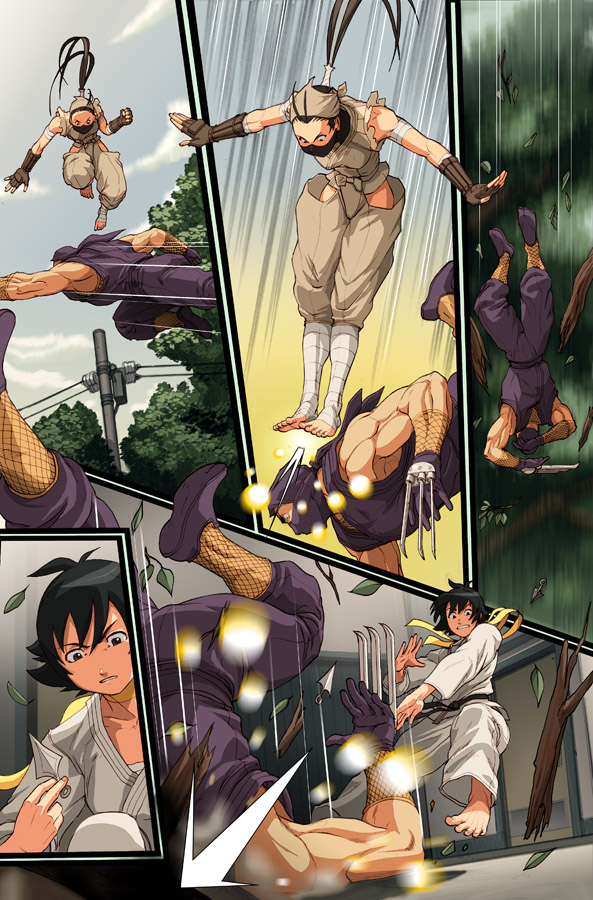
Street Fighter Legends: Ibuki from Udon Comics is another new series with a female focus, though a different endeavour from the book above. Like any Gen Xer I paved my way through high school via button mashing on Capcom’s classic game, but I haven’t followed the franchise in the years since. Udon produce lovely, kinetic comics though, so this was a purchase on a whim. Written  by Jim Zubkavich with art by  Omar Dogan, who worked on the Chun-Li Legends series, this premiere ish mixes light high school drama with face kicking action. I’m unexposed to the newer Street Fighter characters, but this explains Ibuki in a very likeable fashion.

She’s a Japanese teen in a ninja school who also goes to a regular school and uses a mobile phone and has too many clothes for a stealthy fighter and this issue balances both of her lives well. There’s also a new arrogant girl at school who challenges Ibuki to a fight, a secret cabal of ninjas called Geki and a conclusion that reveals next issue’s addition of another SF character. The whole tale bounces along well, with a great touch in pacing from  Zubkavich and suitably light yet frantic action scenes from Dogan.

Since we’re talking about girls – Whiteout. I saw the Kate Becksinale starring film recently and it wasn’t as bad as the critics led me to believe. Based on the 1998 Oni Press OGN from Greg Rucka and Steve Lieber, it tells of a U.S Marshall trying to solve the first murder in Antarctica before a deadly storm crashes on their doorstep. It’s a bit long and not full of surprises, and there a few changes from the book, but it was entertaining enough. Kinda like 30 Days of Night without the bloodsuckers.

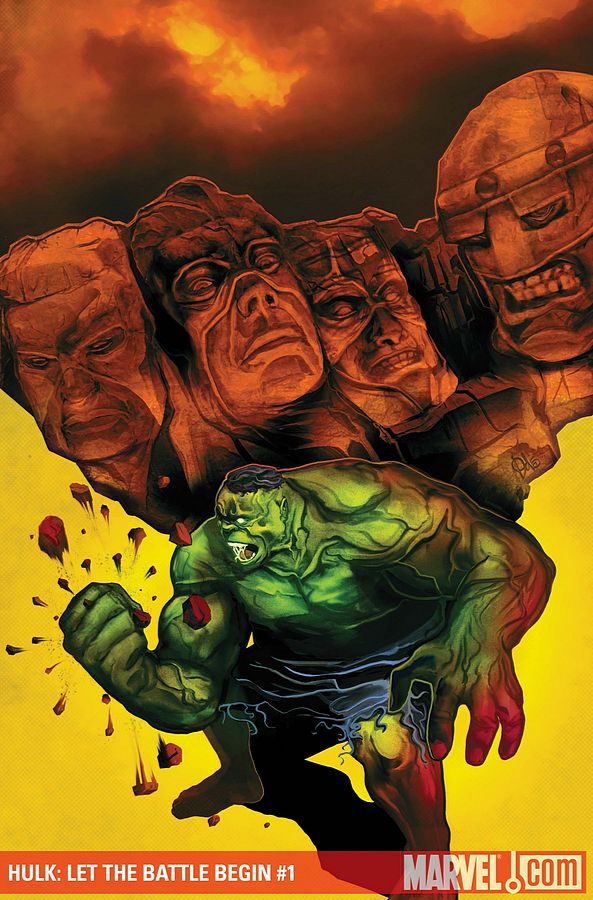
Hulk: Let The Battle Begin #1 Review

As faithfully and thoroughly documented by Rich Johnston over at Bleeding Cool, it’s been an emotional rollercoaster for comics fans hoping for a few very cheap Marvel TPBs from Amazon. As many of us discovered – yep, it was too good to be true. However, the beauty of being a loyal fanboy or girl is that every week holds the promise of some outstanding new comics, and this little puppy is one of them.

Jesse Blaze Snider continues to prove his skill as a scribe with his pulse on the core of the characters he writes. Dark romance with Vertigo’s Dead Romeo series, the playful cast in BOOM!’s Toy Story and now his great tale in this Hulk one-shot. The guy knows what he’s doing and obviously spends quality time thinking about the specific traits of the characters he’s writing. As anyone who’s enjoyed Toy Story (his 2nd issue is also out this week) already knows, Snider has quite the knack for bringing out the authentic personalities of each of the toys, even if they only utter a few sentences. Likewise, this standalone adventure starring the Green Goliath feels like a purpose built Hulk story, rather than just a bland tale featuring a brute who smashes tanks. Snider brings to play the humanity of Bruce Banner and the rampaging might of his emerald alter ego with equal aplomb.

In the first two pages of Let The Battle Begin, we are given one familiar Hulk element with his “stupid purple pants,” and a new element that makes perfect sense for a rational scientist (a small survival kit in those same pants) as Banner wakes up post-Hulk in the middle of a desert. I should point out that this tale is set sometime in the past, as Hulk’s simplistic threats, and Thor in his old duds reveals. As Banner hitchhikes to the nearest town as part of the post-Hulk routine he’s done many times before, we are given flashbacks to unveil just what went down the previous day. Basically – a massive brawl with The Wrecking Crew in the battleground of Mt. Rushmore. Snider paces it very well, and throws in some surprising humour so that it makes the kind of Hulk fight we’ve seen so many times before appear refreshing and wholeheartedly enjoyable. With hitting with sticks, jokes about haircuts and groin grabbing it’s a great sequence that never comes across as silly or irreverent. In fact Snider boils down the essence of Banner wonderfully, as the captions of his inner thoughts show, as Banner has conversations with the townspeople and just tries to live a normal life. He applies the same focused analysis of Banner’s other side (y’know, the green one) that makes this a superb entry level adventure for the Hulk curious. Within just a few pages Snider sums up the complexities of Banner/Hulk in a way I haven’t seen since Peter David wrestled with Ol’ Greenskin.

Snider isn’t alone on this tale though, and artist Steve Kurth matches the plot with some great images. A slightly sketchy style similar to Bryan Hitch’s, Kurth’s grasp of facial expressions is bordering on masterful. There are a few misshapen missteps, but generally he tackles the pages with ferocity and humanity. Banner’s messy hair, the enthusiasm of a Hulk fan/hotel clerk and the confidence that drips away from Thor’s bloodied face are all great touches in this hectic day-in-the-life-of Hulk tale. There are a few close ups that appear like snapshots, brimming with honest emotion.

Also included is a short story written by Mark Parsons and Tom Cohen that originally appeared in Marvel Comics Presents #9. With art by Ed McGuiness it of course looks brilliant, even if Kelsey Shannon’s colours take a while to get used to seeing over the monstrous McGuiness style. Excellently titled Gamaragnarok it focuses on the harsh world of the future Hulk, Maestro. It’s very different from the preceding pages, with its serious story of war, but it sure looks pretty.