
 Okay, here’s a look at 3 recent indie first issues.
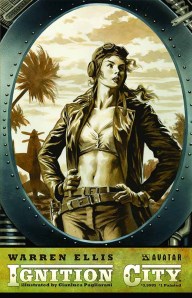
I haven’t read a lot of Warren Ellis’ work, though I’m familiar with his recently wrapped (but not finished) Anna Mercury, also from Avatar. It was a simple and unashamedly fun 4 ish mini centred on a red head’s crazy sci-fi adventures. Similar to Mercury, in that it stars a sassy female character surrounded by men in a mish-mash world of hi-techerry, with low-tech solutions, Ignition City is entertaining enough. City throws in lots more swearing, vomiting and toilet humour than an America Pie film. It’s amusing in a way, but not exactly novel. Fans of Ellis will know exactly what to expect. He seems to present similar ideas in new packaging. I’m not saying he’s not a great writer. He definitely is, but perhaps he’s over this quasi sci-fi vibe he’s dealing with now, he can show the diversity he’s capable of once more. City is concerned with Mary Raven, a pilot who travels to the grimy titular location to discover what happened to her famous father before he died. Gianluca Pagliarani’s art is mildly distracting. Facial expressions often look awkward, but he draws ugly cosmonauts and grimy, steel plates well, so that’s something. The 1956 setting is sold ably with his unusual designs for weapons and transport, as well as the look of Earth’s last spaceport. Its diversions from our history’s space race and its effects on he world’s superpowers are played out with promise, but this title is off to a slow start. For Ellis fans only.
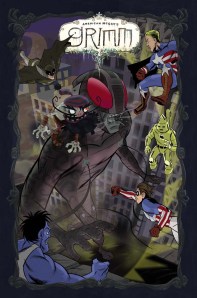 IDW’s American McGee’s Grim is a new series bringing the apparently popular game character to the printed page. Grimm is a surly pirate-like dwarf who runs amok through fairy tales, jumping on things wit his butt to put the darkness back into the tales. Yes, that’s right. I’ve heard of American McGee (yep, that’s his real name), and his games such as Alice, and Scrapland, but never played them. Grimm is currently being released weekly through GameTap.com. Written by Dwight L.Macpherson, each issue of this mini-series is focused on Grimm’s intrusion into a different genre of comics. Naturally, first up are do-gooder superheroes. I didn’t laugh once. There’s just not enough room to play with. It’s a vaguely interesting concept, as Grimm empowers the assorted baddies to defeat the ever-victorious Freedom Friends, but it’s all been done before. Lobo, the recent Bizarro arc in Action Comics, or even Justice League International have all run with this idea, but they were given more than 22 pages. Once Grimm has introduced himself in the first 6 pages, the remaining 22 are just a one-sided battle during a parade through the streets of Megalopolis. There are over a dozen costumed characters – all the obligatory homages to popular characters, but none are obviously given the time to develop character. Superheroes being surprised that they’re getting beaten just isn’t funny, by itself. Grant Bond’s art does work though, with its loose Mike Allred style and Golden Age colouring, and having Grimm rendered in a style separate from the rest of the universe is a nice touch. I’m sure MacPherson is an accomplished writer, as he’s been doing this for a while but he’s not given a lot to work with here.
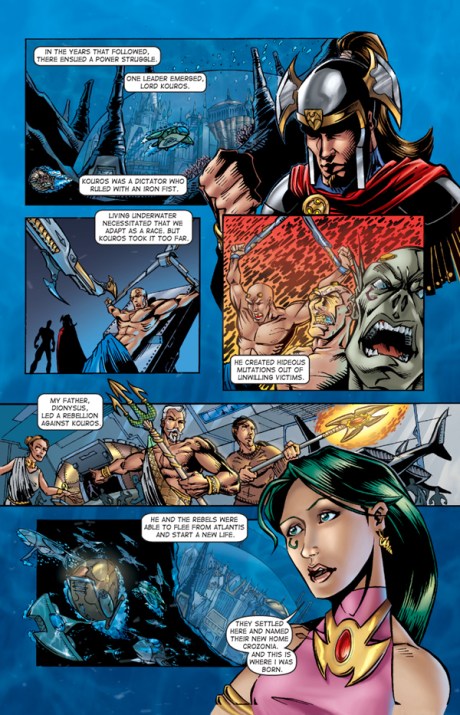
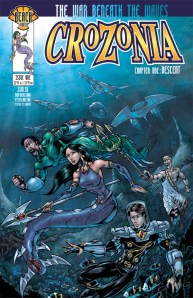 The team behind Beach Studios, and Crozonia must be a confident bunch, competing with Fathom and its assorted spin-offs from Aspen MLT. Like the late Michael Turner’s best creation, this new series is focused on an attractive young woman torn between two undersea worlds. Writers Jim Su and Dan Merisanu have wisely set this story in 1948. I don’t know why exactly, but it’s enough of a deviation to make things a little more interesting. Essentialy a young man, Matt Stark works for a publisher, with hopes of becoming a writer. One bad day he realises that perhaps his dreams are fruitless, so hits the bar and goes for a walk at night. Then he sees the aforementioned woman “drowning” and dives in to save her. Like Lenny from The Simpsons says, “Alcohol and night swimming – it’s a winning combination!” Matt becomes the rescued instead of the rescuer and wakes up to an amazing undersea city. The woman he attempted to save is actually a princess and a war is brewing. The whole issue has 1996 written all over it, from dialogue to the early-Image like art. The up-sides are some groovy pin-ups and Jim Su’s encouraging reflection on the journey it took to get this to print. So far Crozonia appears to be something that comic book newbies would gladly read, but those hankering for something more contemporary should look elsewhere. It’s not without promise though, and the production values are higher than the average indie (or even Big Two) book. With three colourists, including Su (who also did the lettering!) the look of this issue does hit above its weight class. With some more character development and surprises it could be one to watch.
 Image’s
 This is one of those books I ordered from Previews simply because it looked like something different. And it certainly is.
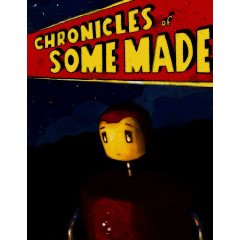 I have a soft spot for indie comics. At least a third of everything I order from Previews is from relatively small self-publishers. Two things struck me about this book; the gloomy yet intriguing cover and the fact that it’s from a Xeric Award winner. Published by Passenger Pigeon Publishing, Chronicles is a simple, black and white 96 page one-shot. Writer/artist Felix Tannenbaum clearly has some skills. However, what is also clear is that he’s a far better writer than an artist. Judging by the work on
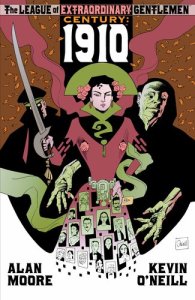 This third volume of the League of Extraordinary Gentlemen opens at the bedside of a sweating man with feverish dreams involving a young lady swimming naked and cloaked cult members’ ambitions to create a Moonchild, whatever that may be. As the man, Tom Carnacki, the ghost finder wakes he speaks of his night-time adventures to his fellow team-mates, Orlando, A.J, Mina Murray and Allan Quartermain. Thus we are introduced to the latest batch of “gentlemen.” This has been an extraordinary series from the outset. Well, mostly. Writer Alan Moore (Watchmen, From Hell) and artist Kevin O’Neill unleashed their concept of famed adventurers from the annals of literature upon the world in 1999. Mina Harker, from Bram Stoker’s Dracula was tasked by British Intelligence to form a team and gathered Allan Quartermain, Dr. Jekyll, Captain Nemo and others along the way to saving London. The second volume was a great tie-in to H.G Wells’ War of the Worlds while the third was a stand-alone graphic novel entitled The Black Dossier. Dossier was not the high point that the first two series were, mainly due to its varied narrative and frequent use of Moore extras such as prose pieces, letters, maps and the like. The greatest asset throughout the series has been the constant relationship of Harker and Quartermain in the different time periods. Dossier was light on that but did fill in some details about other incarnations of the League, reminding comic readers again that Moore is no slouch when it comes to research.

 Writer/artist

 Tales of the Black Freighter
 Under The Hood
 I always admire those who risk their resources by doing something truly creative. It’s even more important in these days of Diamond’s recent changes that make it harder for the ‘little guys’ in the comic book biz to get their work noticed and appreciated by a worldwide audience. So, firstly my hat is off to Gibson and Danks, and the multitude of self-publishers like them. However, apart from all that Harker is genuinely entertaining, and it’s obvious that it’s a labour of love. From writer Roger Gibson’s nice introductions in each issue, that offer an honest peek into the process of creating a comic, to artist Vince Danks’ efforts on the art, which must be time consuming, it all makes this a pleasant change for those raised on a steady diet of spandex soap operas.
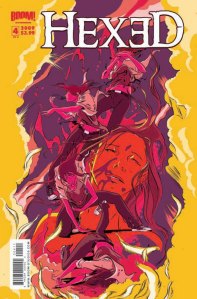 This has been an excellent series with every issue. It’s been tightly scripted with a genuine momentum, and especially when compared to the disappointing finale of The Remnant, this is a truly satisfying conclusion to a great adventure.
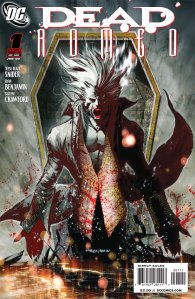 I grabbed this for 2 reasons – the cover and the name. They’re both awesome. Written by Jesse Blaze Snider (yes, he is a musician, the son of Dee Snider infact) and pencilled by Ryan Benjamin this new six issue mini-series is kind of like Twilight for the manly.
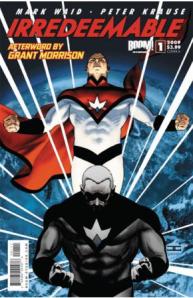 Wow. Just – wow. I’ve never doubted Mark Waid’s mad skills behind the keyboard. The guy knows how to write good superhero comics, and has done so for years. Anyone who’s read Kingdom Come will agree. Now that he’s the EIC of BOOM! Studios, he appears to be ramping things up, free from the tight editorial reigns that The Big Two can sometimes choke a writer’s potential with.
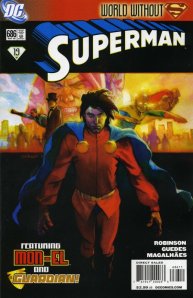 I picked this up on a whim last week and have only now forced myself to read it. I’m glad I did. I followed Superman for years after his Death in 1992-93, which brought me firmly into comics. Then I gave up on his books, only following his latest adventures in JLA or Superman/Batman. Then Geoff Johns did wonders with the character, specifically with his re-introduction of Braniac. Now Superman is leaving earth, and his own title. Or titles. As of this issue, Superman will not be appearing in his titular series, or in Action Comics. He’ll be replaced in the latter by the new crimefighting team of Flamebird and Nightwing, and in this issue we learn who’ll become the new “Superman.” Or Supermen. As was the case in the awesome World Without A Superman storyline that lasted almost a year after his death, DC proved just how strong his supporting cast is, and do so again here. As Supes makes a new home on New Krypton, he’s filled in by Mon-El, his similarly powered hero, and returning heroes The Guardian and Steel, who both played a big part after Supes’ death. Supes appears in flashback cameos as he says his farewells and goes on his recruitment drive. Mon-El gets a secret identity, in Jonathan Kent, taking the name of Clark’s recently deceased father, and beats up on female baddie Rampage, while realising he’s got a lot to learn about superheroics. It’s awesome to see Steel and Guardian back, if purely for sentimental reasons. John Henry Irons is a great character and held his own series for years, but hasn’t been much of a player in the DCU lately.
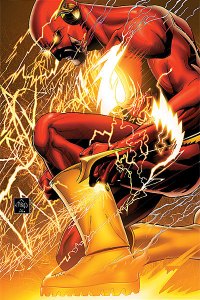 Like most readers, I felt disappointed after reading this issue. Sure, superheroes come back from the dead all the time, but Barry Allen, who for a generation of readers wasthe Flash, was dead for a long time. He gave his life to save the world, or worlds, from the Anti-Monitor in 1985’s Crisis on Infinite Earths. Virtually unseen since then, Barry’s mantle was taken over by his nephew Wally West. In my mind, Wally isthe Flash, and then when Bart Allen showed up as Impulse, and later Kid Flash, that was enough to fulfill my speedster requirements. So why bring Barry back? Good question.
 comicbookjesus