North 40 #1 Review

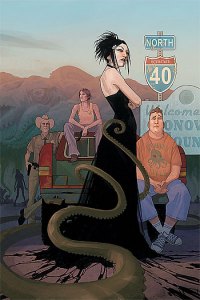
North 40 #1This new series from the DC imprint Wildstorm is a freak fest and I think it will continue to build upon the chills. Written by Aaron Williams (PS238) with art by Fiona Staples (Secret History of the Authority: Hawksmoor) the series is like a creepy European horror film that they’d only show on TV past midnight. With hints of BOOM! Studios’ Cthulhu Tales mixed with the nasty small town characters of Texas Chainsaw Massacre and Deliverance North 40 launches from the gate like a crazed horse with flaring nostrils and bleeding hooves. We are the terrified jockey gasping for air and wondering where this strange beast beneath us is going.

The series is set in Conover County, which is the kind of town where everyone knows each other and where there’s nothing to do except drink, fight or gossip. That all changes after two foolish high schoolers open what looks like the book of the dead, Necronomicon. Now if you roll your eyes and start thinking this sounds like the plot of a cheesy ’80s film with bad lighting and rubber monsters, you’d be wrong. This is a genuinely atmospheric tale that happens at breakneck pace. Scenes never really last longer than to establish the various characters (veteran sheriff, bored young waitress, town outcast, etc) before horror knocks on their door in the form of flying vampire creatures, odd voices that order an arcane ritual and other assorted weirdness. Every character and scenario is interesting enough and Williams handles realistic dialogue colliding with fantastic chills with a superb blend. 

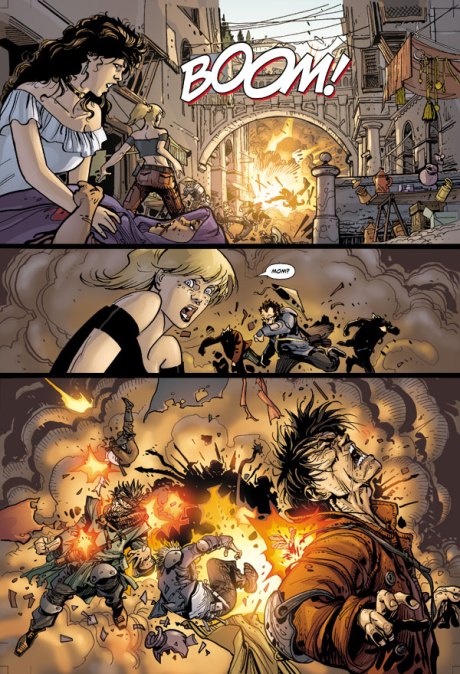
Staples’ art is reminiscent of the light touch of Phil Noto, with few lines and muted colours. It’s not an approach I thought would’ve worked in this context, but it really does. Staples sells the environment dutifully, with its parched lawns and endless sky. 

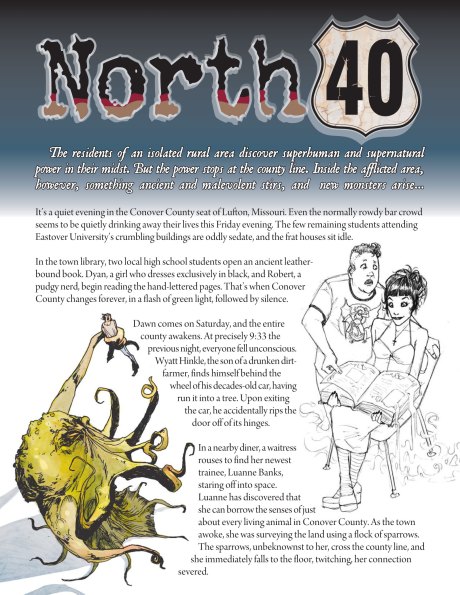
North 40 could just have easily been a Vertigo book and there’s an interesting behind the scenes 2 part look at how the series developed over at the new Wildstorm blog, with a glimpse below. Also included in this issue is a 3 page preview of August’s Red Herring 6 ish mini-series.

For fans of mature horror and people in desperate situations, North 40 will help you get freaky.

north-40-pitch-book1

Ramblings For Early July

Some random thoughts that need escaping from my mind to my keyboard.

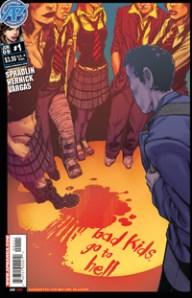
Bad Kids Go To Hell #1I read Antarctic Press’s Bad Kids Go To Hell #1 on the train today. It was the name that caught my eye when I saw it in Previews 2 months ago. AP are a great little publisher and with titles like David Huthchison’s Biowulf and Rod Espinosa’s excellent Prince of Heroes they deserve to be noticed. Bad Kids is not of the same ilk, but it’s good to see AP branch out from their manga flavoured digests. It’s written by Matt Spradlin (or Spadlin according to the intro) with art by Anthony Vargas. The premise is The Breakfast Club meets Buffy’s Hellmouth. A construction crew opens up a portal of some sort and then 3 years later the Crestview Library opens on that spot. Six students are brought in on a Saturday morning for detention. It’s an extra-sized debut but there’s no real smattering of the horror to come just yet, and all of the students are somewhat stereotypical (jock, goth, nerd,etc) but when they’re not swearing and talking about sex the dialogue’s not bad. 4 issues should pretty much say all there is to say with the concept and Vargas’ work is realistic enough in this context.

Rapture #2 from Dark Horse is great. The first issue was a splendid intro and Mike Avon Oeming and Taki Soma’s tale of separated lovers in the apocalypse works well. It could just as well work without Evelyn’s calling and her mystical spear and guide, but the emotion really comes through. Oeming is always a master of the page and with this series he looks to be trying different styles throughout the issues, and it works a treat.

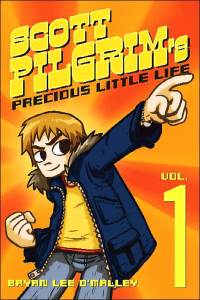
Scott Pilgrim Volume 1The Definitive Edition of Codeflesh from Image is far too expensive. $40 for a Hard Cover on flimsy paper? Nah. It’s an OK tale, by writer Joe Casey and artist Charlie Adlard and it’s good to see the series not suffer from its sporadic publication. The tale of a masked bail bondsman chasing jail skipping freaks is a grand idea and Adlard’s art is dark but not jaw dropping.

Alex Robinson’s black and white digest Too Cool To Be Forgotten from Top Shelf. It’s a slow start and the plot is almost straight out of a Disney film, but Robinson takes the tale of a middle-aged man who gets hypnotised to stop smoking and relives his high school years instead a realistic and un-corny tale. It goes beyond the simple art to poke the heart, kinda like that Adam Sandler film, Click.

I read the first two digest sized volumes of Bryan Lee O’Malley’s Scott Pilgrim series from Oni Press in quick succession. Girlfriends with names like Bond girls, a healthy respect for comedic timing, retro video games and a dose of fantasy. I can’t wait to see how all this translates to film. If Kevin Smith was a comics creator instead of a film maker, he’d be making books like Scott Pilgrim.

Star Wars: Invasion #1 Review

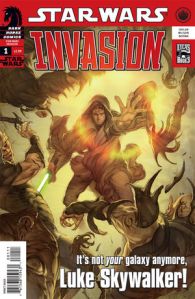
Star Wars: Invasion #1Now I’ve probably read less than forty novels in my life, but my younger brother is a huge Star Wars fan and for the last few years has made a point to read every SW novel he can get his hands on. I too share his enthusiasm for George Lucas’ greatest work, but haven’t delved as deeply in to the Expanded Universe that broadens the scope of events seen in the films. I have read a few of the novels which centre on the vile Yuzzhan Vong however and have loved them. This alien race which despises technology and is immune to the ways of the Force is one of the best creations in the Star Wars world. It’s not easy to create credible enemies for the powerful Jedi, but as I read of the Vong I was instantly scared and sickened. I always thought they’d make an awesome enemy in a film, game or comic adaptation. And here we are. Dark Horse knows how to handle licensed properties like no-one else. They’ve taken Star Wars in to bold new places and this latest mini-series looks to continue that tradition. As editor Randy Stradley mentions in the afteword, now is the time for this comic.

Written by fellow Aussie, and playwright Tom Taylor Invasion is a five issue mini that follows the Yuuzhan Vong as they focus their horrific marauding ways upon the peaceful Artorian people. Obviously, the Artorians have no idea what’s in store for them, and no real defence when the attack comes. Most are carried away as terrified captives by the brutal scaly creatures, while the king (a veteran of the Battle of Hoth, as seen in The Empire Strikes Back) and his risk-taking son Finn  do their best to save their planet. The focus on this 40 pager is not the Vong. In fact they hardly appear, but when they do they look as horrific as I imagined when reading the books.

This series is set 25 years after the first Star Wars film amid the New Jedi Order era, in which an older Luke Skywalker is gathering fresh Jedi recruits. He appears here and reminds all that he is one bad dude when he wants to be. So far it doesn’t appear to tie in to any of the Vong novels so I’m curious as to where Taylor and artist  Colin Wilson (2000 AD) take this. The desperation is laid on thick with the quick battle on Artoria and Skywalker shows interest in training Finn as a Jedi, which is something that holds promise.

Wilson’s art is detailed, with a flair for costume design and page design, particularly in the numerous fights. There have been so many alien races and planets seen in SW over the decades, but Wilson does an admirable job in the few pages he’s given to flesh out the people of Artoria with a Middle Eastern flavour. Wes Dzioba’s colours add a great richness and depth to Wilson’s pencils, making the pages pop with  variety.

It’s an intriguing set up and I hope to see more of the Vong’s harsh religion and culture in the following issues, as that’s one of the things that make them so unique. With the novels, there’s some great source material to mine from. I look forward to this being a dark and ominous series, and hopefully the rest of the Skywalker clan will show up at some point.

You can see a preview of this ish here. There’s also an original 16 page preview on starwars.com by the same creative team set before this first issue.

Star Wars: Invasion #1 p8

Marvel Divas #1 Review

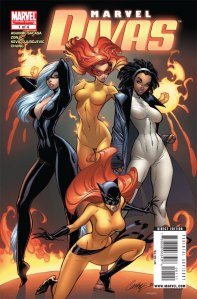
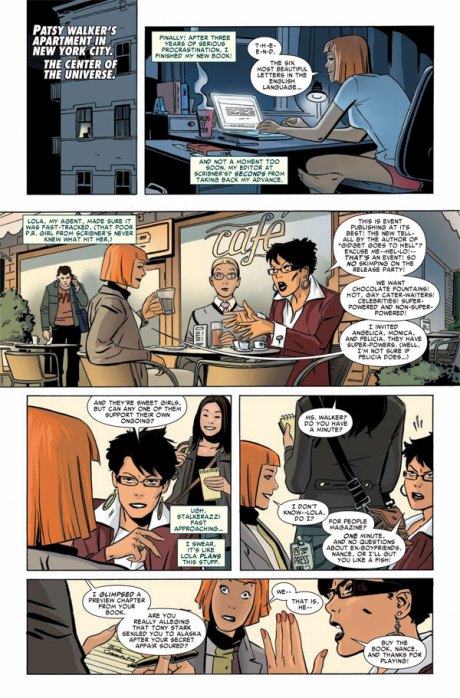
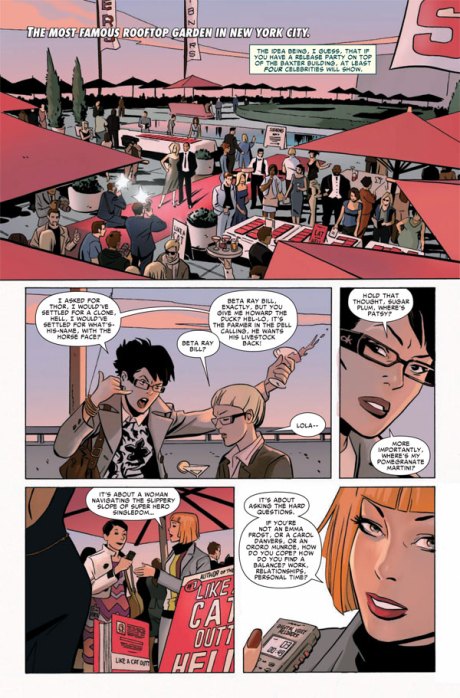
Marvel Divas #1I have a feeling that I’m going to lose any fanboy cred I may have with the next sentence, but I’ll say it anyway; I enjoyed Marvel Divas. Of course, I also liked Twilight, so perhaps it’s no surprise. The best, and most obvious, description of this four ish mini is Sex and the City in the Marvel U. It’s an apt indication of what lies in these pages. Roberto Aquirre-Sacasa’s playwright tendencies show through with great aplomb. He has a terrific handle on dialogue. Witty, casual and sometimes funny, it’s kind of like Kevin Smith or Joss Whedon. Kind of.

Giving a mini-series to four superheroines who are also BFFs is a bold move, but as is the constant cry of fangirls, there really aren’t many titles with chicks in mind. There’s far more talking (about boys, sex and parties)than fighting and this could just as easily work without Hellcat, Photon, Black Cat and Firestar as you’d never know they were superheroines. There’s the occasional Marvel cameo (Black Panther, Son of Satan, Brother Voodoo) and some slightly odd lines that veer closely to fourth-wall-breakers. And would busy superheroines really go to a glitzy book launch? Maybe.

This book is light and fluffy and there’s a loose plot about Patsy Walker’s novel debut and Felicia Hardy’s plans for a detective agency and a last page where one of the Sisters of the Spandex Pants reveals she has cancer. Where this all goes is anyone’s guess, but it’d be a safe bet to say there’s more hugging, tears, and clingy boyfriends. Tonci Zonic’s art fits in to this daytime soap opera like a leather glove on a well manicured hand. Reminiscent of Marcos Martin at his best, it’s simple yet expressive.

It’s not exactly the sort of book that a fanboy can give to his uncertain girlfriend or wife and declare, “Here honey! Finally a comic with girl superheroes! You’ll love it!” There’s too many Marvel U references in it for that, but if you want something different and enjoyed The Notebook, then don’t feel ashamed by taking this to the counter. 

Marvel Divas #1 p1

Marvel Divas #1 p2

Cry For Batman’s Justice

I haven’t been this excited about the Justice League for literally, years. I have virtually every issue of JLA since Grant Morrison and Howard Porter breathed new life in to the characters back in 1996. Morrison got the JLA. He brought brash, epic storytelling that matched the heroic icons represented by the League. After he left, it was OK, with a few high notes thanks to Mark Waid, Joe Kelly and Brad Meltzer, but the last 2 or 3 years I’ve really only been buying the title because the completist inside me feels compelled to do so.

Cry For Justice #1

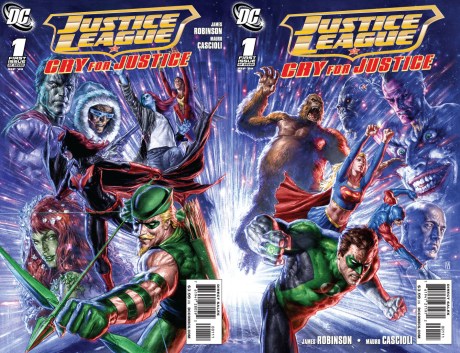
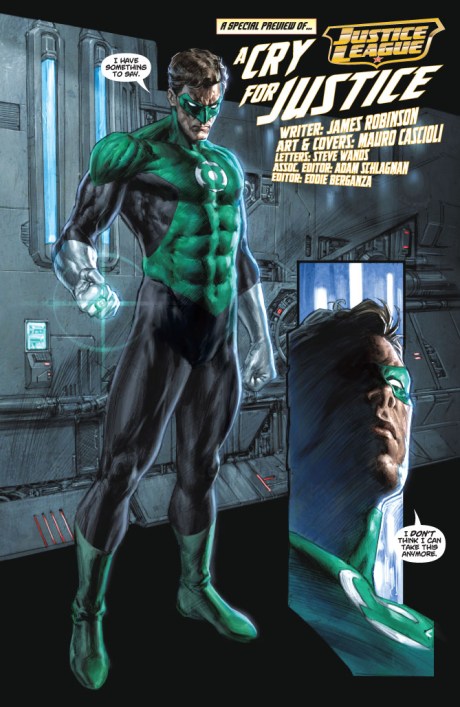
However, James Robinson is now writing the League and it’s time to get excited once more. This is the best League since Morrison. Cry For Justice is a 7 issue mini-series that effectively stars a new JLA. Headlined by a disenchanted Green Lantern (Hal Jordan) and a mish-mash of DC superheroes, this is no longer the JLA-lite we’ve had in the last year or two. This is the JLA with espresso in their veins. What’s most intriguing is the line-up. When it was first revealed it was somewhat perplexing. Hal and Green Arrow make sense, as does Ray Palmer (The Atom), but Batwoman, Congorilla and Mikaal Tomas (Starman)? They’re odd choices, but as Robinson describes in the 5 page regular feature, that’s what he wanted. The mix of new and old, or old made new, heroes, such as Freddy Freeman as the new Captain Marvel means that the interplay will be as exciting as the villain bashing. Robinson also uses the extra pages to give brief backgrounds for the roster and his buddy Len Wein writes a 2 page Congorilla origin (a hunter who had his mind transferred to a golden gorilla-that’s either cool or laughable).

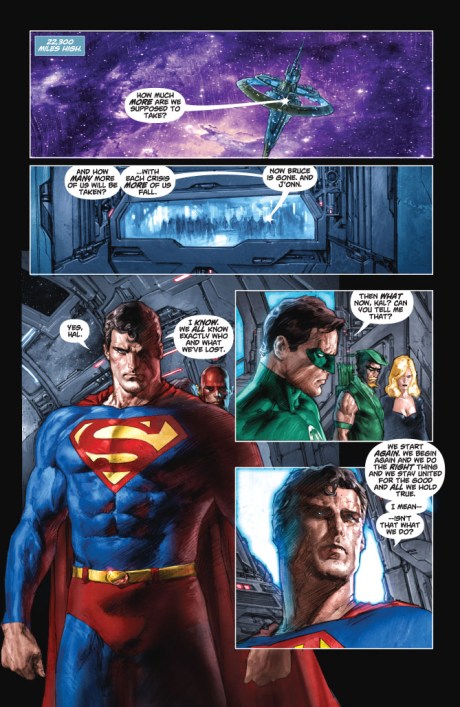
Being a first issue, it’s all set up, with the opening pages dedicated to a fed up Hal confronting his JLA team-mates in the orbital Watchtower, while his pal Ollie also tags along for the justice serving adventures. The rest of the story shows glimpses of the rest of the new team as they cope with recent losses and find a burning desire for proactive justice. Robinson’s comfort with these characters is superb. Hal and Ollie’s dialogue is just like two old friends, and having written Starman for years, he knows the blue-hued alien Mikaal Tomas well too.

Batman and Robin #2Mauro Cascioli wowed many with his painted art on the Trials of Shazam mini that moved Freddy Freeman to drop the Junior from his Captain Marvel moniker. These pages are lush and realistic, not in an Alex Ross way, but with texture and tone and superb backgrounds. These characters look foreboding and heroic and scary. Thank you Robinson and Cascioli for giving the JLA CPR. It is for DC fans, but Robinson also knows that some of these heroes are more familiar than others and doesn’t act on assumed knowledge. This is going to be an exciting series and thankfully, once it’s over Robinson will be taking his skills, and possibly his new crew, on to the ongoing JLA series.

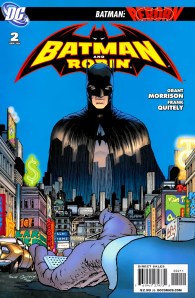
Batman and Robin #2 is just as good as the first issue. Some may find the circus talk frustrating, but Morrison shows Alfred’s concern for Dick, Dick’s frustration with Damian as his new Robin, and his weariness about being the new Batman very well. He also wisely brings up the idea of the Gotham cops, including Commissioner Gordon, knowing that this Dynamic Duo is not the old Dynamic Duo. Frank Quitely draws action scenes of such fluid motion you’ll feel like you’re watching a John Woo film. Little touches like Dick hating the cape as it makes him “way off balance,” and Alfred encouraging Dick to treat his new cowled role as exactly that, like a part in a play remind us that Morrison knows how to handle realism just as well as freaky villains and life and death scenarios.

Cry For Justice #1 p1

Cry For Justice #1 p2

Fat Chunk Volume 2: Zombie Review

Fat Chunk Volume 2: Zombie“What do you think we do? We grab a couple of chainsaws and start hacking up walking stiffs.”

“Nice try freak, but you’re not eating my brain!”

“Well you look great! I mean, you’ve hardly decomposed at all!”

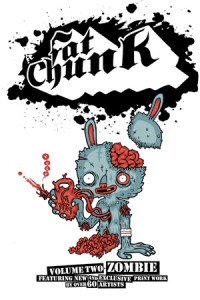
And so on. There’s some classic moments in this great offering from Slave Labor Graphics. Fat Chunk is an anthology series dedicated to giving talented artists the spotlight they deserve. Last year’s Volume 1 was all about robots, while this new follow up is all about zombies. Yep, zombies are more popular than the US President in comics these days and this digest is over 130 pages of black and white undead entertainment.

Most of the stories are 3 or 4 pages, while a few are silent and some have no clear end to the narrative. Like any anthology, not every page is a winner, but with Zombie they’re definitely…unique. There’s a glorious splatter of styles across these pages and I found myself laughing more than I expected. There’s a lot of profanity and raunchy material, and most of the humour is of the gallows brand, but it works. Splendid examples would be the black comedy seen in The New Kid by D Z Greene and Seph77’s Scabby the Cat. They’re funny because they’re wrong.

After reading this, I also realise how adaptable zombies are. In this collection, there’s zombies on blind dates, zombies as the focus of a charitable organisation, as hosts of cooking shows (guess what’s for dinner!), and as literal “working stiffs.”

There’s a wealth of talent out there, and every contributor mentions their website in their credits. The Fat Chunk website also has heaps of previews (some exclusive and updated) and links to more of the artists’ works. A lot of the work here is somewhat similar, with the exaggerated super-deformed style of street mags and hip hop tattoos, or manga-lite stuff of Saturday morning toons being the most represented styles. Some of my faves would have to be Jesus Briosso, Perca, Bill Neff and Aurelio. I hope Volume 3 is in the works.

Props to SLG for getting Fat Chunk out there, and for giving this skilled roster of storytellers a shot at grabbing new fans. If you believe you too are a worthy artist, they’re always on the lookout for fresh meat, er, talent, so give it a go.

Abstract Comics: The Anthology Review

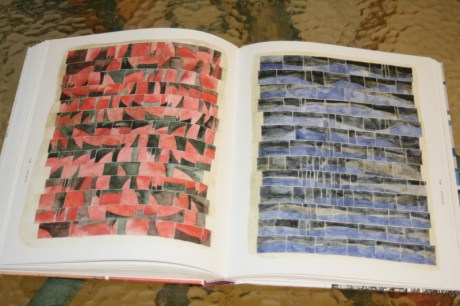
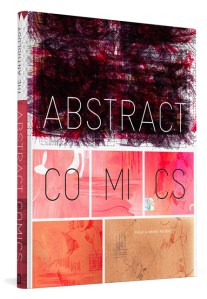
Abstract Comics CoverAbstract Comics: The Anthology is an impressive collection of old and new work with unique pages covering exactly what the title says. Fantagraphics’ bold book covers the years from 1967 to the present, with a selection of abstract comics from over 40 artists.

Now I think I’m a pretty open comics reader. Having primarily grown up on superheroes however, it’s only been the last 5 years that I’ve expanded my reading habits to include indie titles. It was Craig Thompson’s masterwork, Blankets that woke me up to the world beyond spandex and ever since then I’ve pretty much bought an indie title every week.

Abstract comics is a foreign concept to me though. I’m surprised that I’ve never thought of the genre before. It makes complete sense and after pouring through this hardcover from Fantagraphics I have a greater understanding and appreciation for the form. This intriguing 208 page tome includes some of the best work from pioneers in the field, as well as new work created for the anthology by artists including James Kochalka.

The introduction of the book is the only piece with words strung together that actually form an obviously coherent thought. Andrei Molotiu is the editor of Abstract Comics, and quite an authority on the subject. His work as an artist is reflected here and his introductory summary of what abstract comics actually are, as opposed to the use of the word in other art forms, is insightful. Even this obligatory introduction is treated with a loose abstract veneer, with plain text comprising the bottom half of each page, while above it sits the same words through the lens of simple shapes, which reminded me of the Kryptonese language. Yes, even with abstract comics, I can’t help but see things through my fanboy glasses. (There’s also a look at the history of abstract comics here). Molotiu defines the term thusly;

abstract comics can be defined as sequential art consisting exclusively of abstract imagery, and indeed most of the pieces in this volume fit that definition squarely. But the definition should be expanded somewhat, to include those comics that contain some representational elements, as long as those elements do not cohere into a narrative or even into a unified narrative space.

Whew. It’s the kind of talk that gets art students all sweaty. His 8 page introduction is littered with great work as he shows us the history of abstract comics, with examples of a bunch of artists unfamiliar to me to those who I didn’t expect to see, such as Wassily Kandinsky, Willem de Kooning, Winsor McCay and Steve Ditko.

Abstract Comics Intro DetailThings kick off with a great piece from 1967 by R. Crumb, as originally seen in Zap #1. As you’d expect, it’s only 3 pages, but packs a lot of zest, with rounded figures, cheeky expressions and wild imagery. For the next 200 plus pages I was bombarded (in a good way) with every form and technique imaginable. I never knew what each turn of the page would bring. Black and white, pencil sketches,  colour paintings and more – it’s all accounted for. Most of the works are only 3 or 4 pages long, with little or no text and some semblance of structured panels. I found myself treating the book like a portable art gallery as I let the images wash over me and tried to grasp their meaning. With close looks, there are stories of sorts to be told here, but as Molotiu mentions in the intro, abstract comics don’t have a narrative. I couldn’t help myself though and on some occasions examined the shapes in an attempt to form one. However, like all art the point is the enjoyment of the work first and foremost, rather than a desperation to cram it through out structured reasoning.

getsiv-6Molotiu’s work, The Cave was definitely a “wow” moment for me with its bold colours and gem like qualities, as was Andres Pearson’s work, with its swirling organic structures. Through some pages I could see how the panels, or the shapes within those panels, related to each other, which gave clarity to Molotiu’s introductory definition as to why this is different from abstract work done in other fields, such as cinema. James Kochalka’s (American Elf) work is exuberant and playful, as is Mike Getsiv’s. Blaise Larmee’s I Would Like To Live There is simple yet elegant while Life, Interwoven by Alexey Sokolin is 6 pages of increasing fury.

It’s hard to describe the experience of reading this anthology, but it must have been that much harder to choose the artists whose work would be shown here, especially considering this is the first book of its kind and it covers 4 decades. Book designer Jacob Covey must also be mentioned as there’s an undeniable sense of purpose that holds these pages together, from the cover to artists’ credits to last few pages. It’s subtle which allows the abstract comics to own the spotlight.

The book concludes with handy artist biographies for those that would like to discover more about them, and there’s also a useful accompanying blog which features work from the anthology and elsewhere.

I’ll admit that it was sheer curiosity that made me read this, and after enjoying its diverse offerings it brought me back to my art school days when I was exposed to a wide array of artists. It’s obviously a difficult book to review as well, especially as there’s no Good Guy A punches Bad Guy B action, but it was a treat for my often superhero consuming eyes. This is a book for readers who like fine art or those who would like to expand their sequential art experiences. A hearty slap on the back for Fantagraphics for choosing to create this marvelous example of a widely unknown artistic expression.

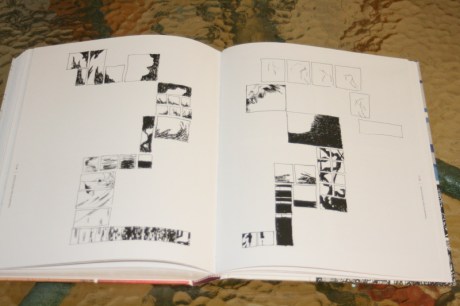
Abstract Comcis Preview 1

Abstract Comics Preview 2

Abstract Comics Preview 3

Irredeemable #4 Review

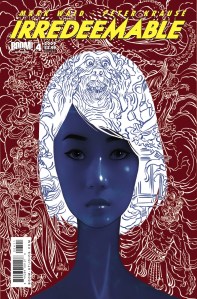
Irredeemable #4There’s a real weight behind this title thanks to the power of the name behind it. I grew up on many Mark Waid written comics. He was one of the creators that cemented my love for sequential art, and primarily superheroes. I can picture Waid typing away at the keyboard with an evil cackle, twirling his moustache and then perhaps tying a damsel to the closest railway tracks while he creates this series. Irredeemable is the product of Bizarro Waid.
With a handy catch up page here, newcomers can understand what’s gone before. However, the summary can’t contain the emotional wallop that Waid and artist Peter Krause have created in the previous issues. If you are new to this title, grab the TPB in August, which is even more tempting as it’s only $9.99.

Basically however, The Plutonian is earth’s greatest superhero, or rather, he was. Now he’s joined the dark side and is fed up with humanity, which is entirely understandable really. We all get that way at times, while suffering fools in our daily lives. However, we don’t have superpowers and the best of us will often show our contempt with a stern word or a rolling of the eyes. Imagine if we had superpowers and then hrew a tantrum. Then things would get real ugly, real quick.

The Plutonian’s former team-mates of super group, The Paradigm are desperately trying to find clues from their ex-friend’s past, in order to discover his weakness. It’s a race against time and they are only making small steps towards an uncertain victory. In this issue, The Plutonian continues his world-wide rampage and in a great scene at the United Nations, shows the world that it is unwise to unite against him, or to lie to him. Singapore suffers tragically at his hands while other countries can only hope to appease his wrath by offering him sovereignty over their people.

Waid’s timing and Krause’s emotional renditions work well together, to reveal the human face of devastation, and the sheer desperation of The Paradigm who show what true heroism really is. However, I feel an urge to know more about The Plutonian’s turning. So far only hints have been given, and there are no real further clues in this fourth issue. We can’t be expected to feel any kind of sympathy for The Plutonian, but a greater level of understanding is due. Rooting for The Paradigm is mandatory, but The Plutonian, while scary due to a lack of humanity also lacks any motivation for evil so far. He’s the bad guy because of what he does, but we still have no concrete idea as to why. The Paradigm apparently know very little about The Plutonian, and perhaps will come to question their trust over the years of a man, or super man, they knew little about.

In this issue is also an 8 page preview of Poe, which launches in July. Written by J. Barton Mitchell, with gloomy art by Dean Kotz it shows famous scribe Edgar Allan Poe as a widower in a mental health facility, facing nightmares about a dead girl, while his brother tries his best to help him. It’s a pretty good intro to the series and looks gothic enough in its approach.

Viking #2 Review

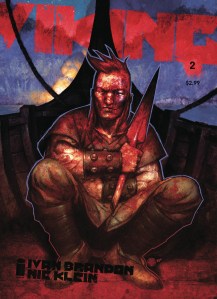
Viking #2The first issue of this rather special 9th century crime series from Image sold out, which was no surprise. This follow-up is not a suitable jumping on point for newcomers to the title, as they’ll be scratching their heads over what exactly is going on. Even regular readers may be too, with its bi-monthly release schedule. Saying that, this was almost as enjoyable as the debut ish. A lot less actually happens, and there is very little dialogue in the first half of the book, but that serves the desolation of not only the environment but also Egil’s loneliness well.
After the butchering last issue, Egil finds himself in a virtual battlefield surrounded by corpses and begins to make his way to his grandfather’s house, where his brother Finn also resides. Egil seeks forgiveness and acceptance but instead receives a beating. In between these events, half of the story is devoted to a king, his adventurous, yet almost imprisoned daughter and a humiliated servant. How this family mixes up with the viking brothers is yet to be seen, but as happiness seems to go unclaimed for characters in this series, I can’t imagine a prosperous future beckons.

Ivan Brandon’s dialogue is great here. He really knows how to create empathy and he does a superb job of capturing the inner turmoil of every character in this issue without being too wordy. That’s a rare skill for a writer. That means that Viking is not a mere blood soaked tale of revenge and redemption that we’ve all seen before. Brandon manages to make the past come alive with a rich world and fully rounded, believable men and women.

Nic Klein’s art is as jaw dropping as it was last issue. He makes full use of the larger format pages and mixes his painted and pencilled styles beautifully. His lighting choices must be mentioned too. With camp fires and torches, I could almost hear the crackle and feel the warmth of the embers. It all seems so – earthy. This isn’t the sort of tale I’d normally buy (even though it’s quite cheap for its size) but I’m glad I took a chance on it.

Viking #2 p1

Ladies First At DC

Detective Comics #854I’m looking at my hefty haul of new comics this week, including the cheaper edition of the 2007 DC Comics Covergirls, which is a very pretty coffee table book focused on DC’s female stars from the last 7 decades. I’m also looking at three issues with strong female leads. Justice League of America #34 is the last ish written by Dwayne McDuffie, which is kind of a shame, especially since he’s just starting to introduce his Milestone characters into the DCU. However it’s no surprise, as he was getting rather vocal about the magic being created behind the curtain. However, at least there’s some strong female superheroes in the series now, with Dr. Light, Vixen, Zatanna, and half of Firestorm as regular cast members. 
DC, and especially boss man Dan DiDio, have copped a lot of flack over the years for killing off female characters, or just treating them with mild disdain. However, even the ardent naysayers must admit that steps are being made in the right direction. This week two new series debuted with leading female Gothamites. Sure, Batman had to die to make way for that to happen, but it’s bold move for DC. Hopefully fans will recognise that and support their risky venture. Are these new series worth supporting though? Yep.

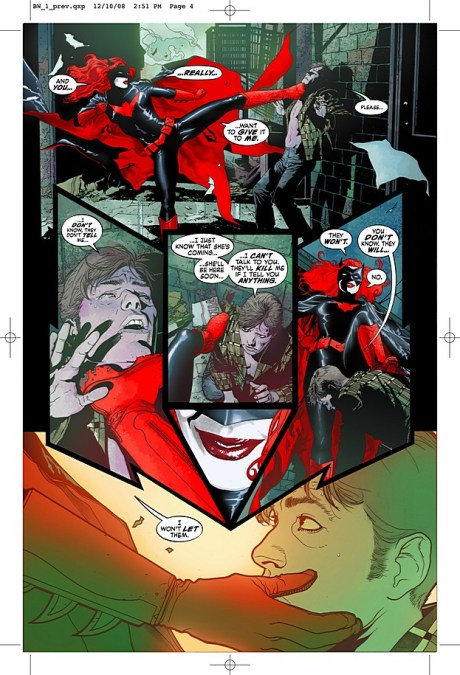
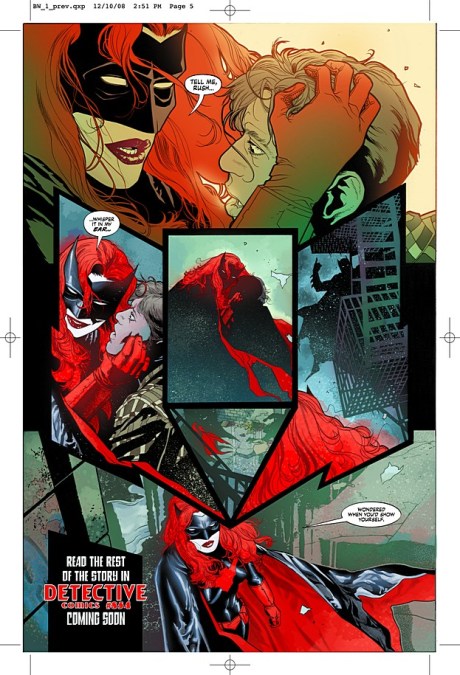
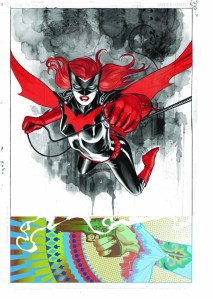
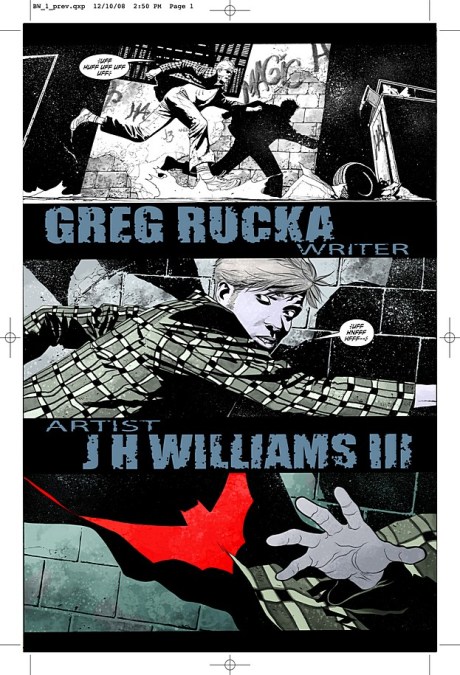
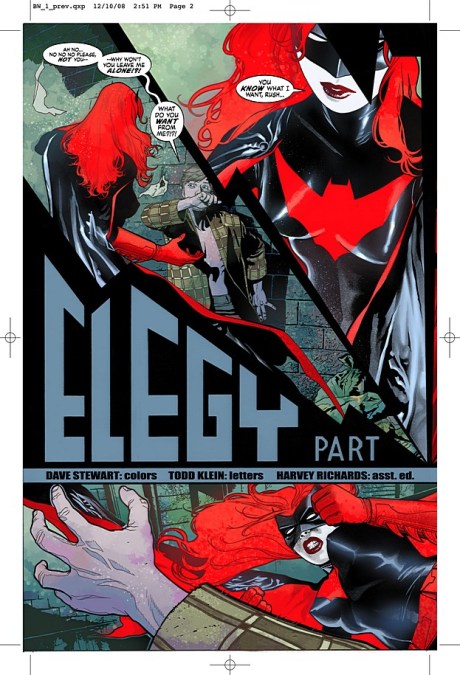
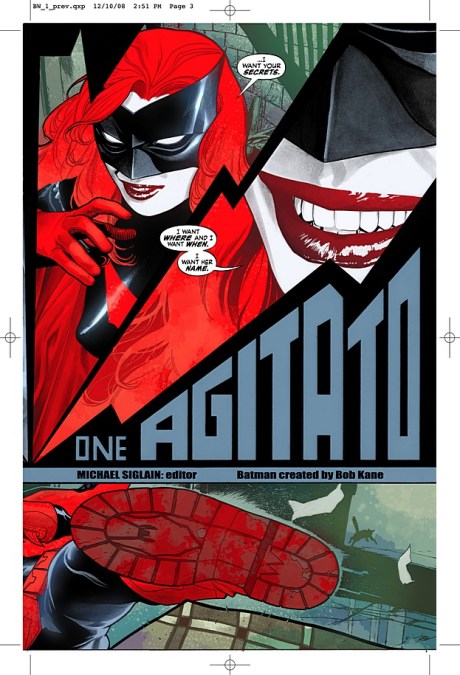
Detective Comics #854 is a lush book. Greg Rucka knows crime tales and handles the new Batwoman terrifically. Kathy Kane made her mark in the pages of DC’s ambitious weekly series 52, but she didn’t have much to do, other than grabbing headlines for her lesbianism. (There’s a historical summary of the character here).Giving her her own series, and DC’s flagship book, no less is – out there. However Greg Rucka and artist J.H . Williams III – that’s a winning combo. The pair appear to be pulling out all the stops to show the fanboys and girls that Kathy Kane deserves this shot at fame.

Gotham City Sirens 1It begins with the leather clad redhead chasing a crim called Rush for information, before a brief encounter with the new Batman, ie, Dick Grayson, who gives her an unnecessary hair care tip. We then see Kathy have a breakup at a cafe before she talks to her stepfather, a Colonel who seems to be her Alfred stand-in. With the visit of pale Alice to Gotham, the new leader of the Religion of Crime and a gun-toting Batwoman staring her down it’s obvious that something odd is being set up. Odd in a good way though. With this new direction, it seems like a Vertigo book in the middle of Gotham. Williams’ fight scenes are beautifully choreographed and he makes the pages his own. When Batwoman kicks butt, wow is the only appropriate response. The dialogue and exposition scenes are designed with more restraint which makes the action scenes pack even more punch.
It makes sense for ex-Gotham cop Renee Montoya to appear as The Question in DC’s new co-feature in this series. Rucka knows Montoya well, having written her for years. With a mere 8 pages he forges a new path for The Question too, as a for-the-people heroine, who answers e-mails for help.

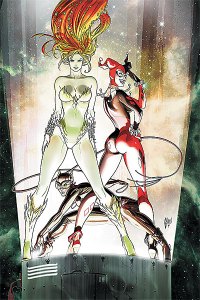
Gotham City Sirens #1 is by the always reliable Paul Dini and artist Guillem March. Poison Ivy, Harley Quinn and Catwoman have teamed up before, most noticeably in the web-toon Gotham Girls. In these pages they continue their hi-jinks. Unlike Detective Comics, this is fun, and funny. It’s not easy to bring laughs from Gotham, but Dini does it so well. The Riddler as Ivy’s catatonic room-mate, a dodgy villain by the name of Boneblaster and a real estate agent who specialises in themed villain hideouts. All this and more means this issue is like a sit-com. Like the three leads, it looks great and is suitably sassy.

Detective Comics #854 1

Detective Comics #854 p2

Detective Comics #854 p3

Detective Comics #854 p4

Detective Comics #854 p5

Extra Sequential #3

Our farewell, or “see you later” issue, before we move to print in January has finally landed. It’s 40 pages of goodness including the obligatory perty pages and reviews. There’s also interviews with sci-fi author Robin Parrish, Brian Cronin from comicbookresources on his new book, Was Superman A Spy? and Wolfgang Bylsma from very successful indie publisher, Gestalt. Check it out below or here.

View this document on Scribd

Swallow Me Whole

Gestalt

Pocket Guide To The Bible Review

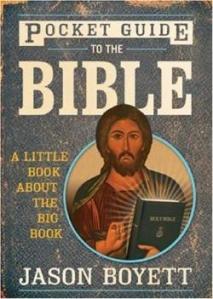
Pocket Guide to the BibleRelevant Books was a spin off of the Relevant magazine that combines two of my favourite things – God and pop culture, though it’s a site for those who aren’t really passionate about either too. Their Books divisions stopped in 2006, when this was released, but there’s still catchy books available, with titles such as The Naked Christian and Everybody Wants To Go To Heaven, But Nobody Wants To Die.

I picked up Pocket Guide To The Bible at a Christian book shop last year and I finally finished it. It’s just less than 200 pages but I sped through this like a hot lunch. Written by Jason Boyett (who also wrote two Pocket Guides one on Adulthood, and one on the Apocalypse) this digest sized book is funny. Yes, funny. Sure it helps if you’re familiar with God’s greatest book but Boyett managed to make me laugh more than when I watched Role Models. That was a very unfunny film anyway, but my point remains. Boyett is a guy after my own heart. He speaks to the iPod, broadband, gaming culture with plenty of Gen X and Y references and an approach that’s refreshing without ever resorting to mockery. It’s obvious this guy has done his homework, as this is basically a condensed form of all that the Bible is. The good bits, the bad bits, the confusing bits and the strange bits. Boyett has unashamedly embraced them all with equal relish.

It’s broken down into tidy chapters such as an A-Z of characters, a summary of what happens in the Old and New Testaments, a history of all the translations over the centuries and a few crazy lists straight out of a late night talk show. It’s punctuated with his casual approach that makes you seem like you’re in on a witty conversation with an old mate. There’s also some great quotes about Scripture from such notables as C.S. Lewis, Abraham Lincoln, Charles Dickens, philosopher Immanuel Kant and Mark Twain (“Most people are bothered by those passages of Scripture they do not understand, but the passages that bother me are those I do understand.”)

I was pleasantly surprised by what surprised me. The history of the different translations since 900 BC and all the translators that were brutally killed for daring to bring God’s Word to the “common folk” is astonishing, and it’s filled with tidbits such as the fact that The Lord of the Rings author J.R.R. Tolkien helped translate the Jerusalem Bible in the 1960s.

The book speeds through centuries of history like a bullet train and it made me want to read more of the Bible to really grasp it. Some will undoubtedly be offended, but to those people I say, “Lighten thee up!” It’s hard to pick my favourite pages, but here goes.

From Boyett’s list of Five Health Conditions That Sound Absolutely Awful – smited bowels, and bloody flux. From Nine Miscellaneous Things You Must Not Do, According To The Law Of Moses – eat a bat, audibly mock the deaf or attempt to trip the blind, or pity a woman who gets her head cut off because she grabbed the genitals of a man who was attacking her husband. Remember, this is all from the Bible, and Boyett uses Scripture to support it all. He’s not making all this up! The best of the rest (of the lists) Seven Lesser-Known Bible Stories That Probably Shouldn’t Be Told To Children, The Four Best Moments For Donkeys, Nine People God Smites, Seven Phrases From The Book Of Judges That Would Make Awesome Band Names. (The Nether Springs, Forsake My Sweetness), and Ten Common Phrases With Biblical Origins. Of course, how could I not mention One Statement By Paul That, When Taken Out Of Context, Makes Him Sound Relatively Hip – “Peace to the brothers.”

Boyett’s also not averse to getting real with it and explains that the raunchy Song of Solomon book is an actual account of two lovers. As Boyett explains it is, “what amounts to the Hebrew Kama Sutra, starring Solomon and his nubile lover. For kicks, here’s a lyrical sample, spoken by the female, “Let my lover come into his garden and taste its choice fruits.” Uh..her “garden?” Not really a garden. Bomp-chicka-bow-wow.”

Sure it’s light hearted, but Boyett is both respectful and entertaining. He doesn’t write anything that will make most Christians throw this in the bonfire with The DaVinci Code. It’s a pleasant reminder that, like His followers, God too has a sense of humour. However, looking at all His mysterious and loving ways throughout history, He at least knows what He’s doing.

In an interesting side note, Boyett has just signed a deal with a different publisher, so the existing book is available now from him (and cheap too!), or you can wait until August when the new edition is released from Jossey-Bass. Either way – get this book.

Berserker #1 Review

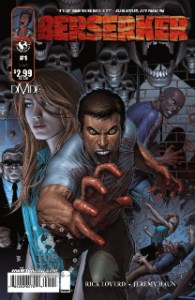
beserker1You know what Berserker is like? It’s like a Rob Zombie film on paper. This first issue will make sense if you’ve already read the excellent #0 primer, but there’s enough going on here to not be completely perplexed.
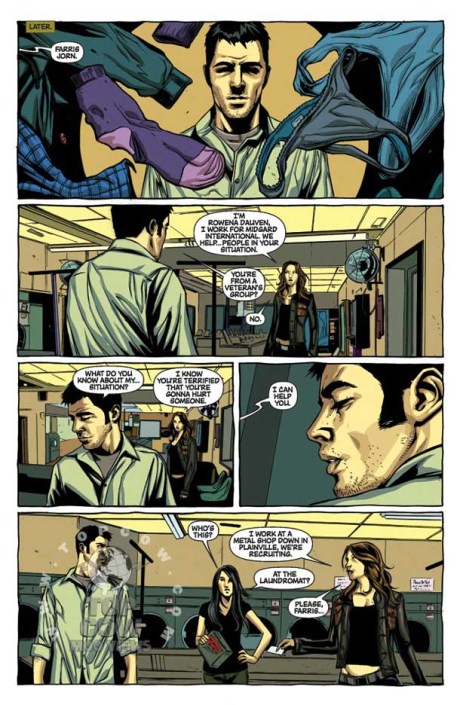
It begins, and ends with a car crash, which leaves the bulk of the issue to deal with the how and why of said crash. Aaron and Courtney are a young couple fed up with their boring high school life. They need a break, or at least an escape, and after Aaron freaks out at a wrestling competition, they decide to take the opportunity to skip town for a new life.

Similarly an older couple, Farris and Eva are looking to leave their dull metal shop jobs and sleazy boss. Readers of the #0 issue will know Farris as the captured Marine somehow cursed with an unexplainable rage and a tendency to separate nearby heads from their bodies. There’s no further explanation as to the whys of all the bloodletting just yet, but the Norse mythology angle that was promised in the solicitations is more prominent in this issue.

We are introduced to two agents of some kind, namely Rowena Dauven and Ray Becket. The latter is apparently, “Asgard’s rising star,” and these two have a tug of war over Aaron and Farris. It’s a quick and brutal fight, and just what the interest in the two berserkers is has yet to be shown, but seeds are planted for future issues.

Writer Rick Loverd (Friday Night Lights) paces things well, and conveys the oppressive nature of a small town existence for the two leads beautifully. Jeremy Haun’s art is rich with blood and pulp and tissue and goo. He seems to be enjoying himself. It’s so grotesque that I couldn’t help but laugh at the black comedy of it all, especially the last page which is similar to the closer of the #0 issue. Haun brings forth the shock and horror of the few quick fight scenes splendidly, like a so-bad-it’s-good horror film from the ‘80s.

Without the Norse angle this could easily venture in to more mundane, schlock territory, but I reckon Loverd and Haun are creating a bold series that goes past blood and guts tactics. This book comes to shelves via Heroes star Milo Ventimiglia and his DiVide Pictures and Top Cow were the best publisher to bring it to. With series like Impaler and The Darkness, they get it, and are building an interesting stable of raw, mature titles. 

Berserker #1 p16

Jackket Knightmare #2 Review

Jackket Knightmare #2I met self-taught artist Cassandra Reyes through christiancomics.net and her first issue of Jackket Knightmare caught my eye, and it wasn’t because of the unusual spelling of the title. Wearing her influences on her sleeve, such as The Crow and everybody’s second favourite X-Man Gambit, she crafted a mature tale about justice and redemption. It was obvious that the first issue was the product of a new creator however, with certain elements being understandably unrefined. However, what a difference this follow up issue is. It’s a remarkable improvement.

This 28 page second issue is black and white and follows Tomas J. Caballero, a man once abused as a child, and the trenchcoat avenger of the title. The link between the men won’t be a complete surprise but it does work splendidly. Their respective missions are at the core of the series, and  in this issue, sub-titled Healing Rains, Tomas learns that his late father’s vacant position as church pastor has been decided, due to a seemingly crafty council.

Knightmare stares down what appears to be a demon possessed man and has a close shave with the cops, which can only land him in hot water next issue. Reyes takes a few bold artistic steps here and it pays off. Drawing people from overhead, as well as a couple kissing are hard to render properly, but she ably does so. The story is a lot easier to follow and the page designs are much more creative. There’s also a short back-up feature called Rival Relic Hunters that isn’t as unique as Knightmare with a distinctive manga flavour, but it’s not the highlight of the issue.

Reyes’ hard work is paying off though. It’s always a treat to see an indie creator start to hit their stride and to see their dedicated efforts begin to bear fruit. The issue can be pre-ordered from Reyes’  Velvet Nightmare Studios here.