
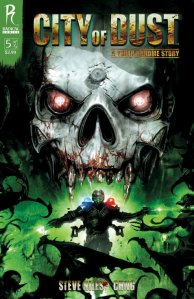
 Bringing things to a tasty close, this horror/sci-fi mini-series from Radical Publishing is the final action packed issue, in what has been an engrossing tale.
As cop Philip Khrome, his partner Sonja and the android Blake enter a secret stairway under a statute of the city’s once revered scientist, Henry Ajax, they discover the library of books that inspired him in creating his robotic monsters that have been terrorising the populace as of late. As we learnt in the previous issues, Ajax’s dream was to remind the citizens of the power of imagination and creativity (which have been banned in this future). However, as Khrome dug deeper into various brutal deaths by monsters including wolf men and zombie look-alikes, he realised that even monsters created by men are still monsters, and they start to exhibit the blood thirsty traits of their literary namesakes.
While Khrome and co. do some quick research about the monsters strengths and weaknesses, Ajax is discovering them firsthand. Defended by his protective Frankenstein creation (who calls him father) Ajax is quickly beheaded, but like any good cyborg, still manages to communicate, apart from his torso.
The leader of Ajax’s fellow creations, Nosferatu learns of Khrome’s plans to bring these mechanical creatures of myth down, and goes on a hunt. Khrome, Sonja, Blake and Frankenstein fight back and blood and metal fill the air.
This is the quickest read of the series so far. There’s far less talking and more action than previous issues. It does seem slightly rushed and could have benefitted from a few more pages, detailing Nosferatu’s rise to power and desire to welcome the growing blood lust inside him. After such a grand build-up over the previous four issues, the showdown is a let down. However, in the last few pages we get the ending we’ve wanted throughout this series, as Khrome realises the mistakes of his past and understands the potential of the imagination. It wouldn’t surprise me if we get another mini-series set in Khrome’s world. I have a feeling Steve Niles has a few more tales to tell yet.
The art is okay in this finale. Brandon Chng, Zid and Garrie Gastonny have similar styles and for different artists, the pages aren’t too jarring. The series’ slick visuals and great lighting and texture effects have given City of Dust a great look in every issue. The Trade collecting the entire mini will be released in May and is well worth a look. It’s built upon a simple, but unique concept and the combination of jet packs and androids, with hungry monsters and brutal deaths is an engrossing one. For those who wished Blade Runner was directed by Wes Craven, your wish is Radical’s command.
 There are very few series I look forward to each month. This is one of the fortunate to make the cut. Along with Geoff Johns’ Action Comics, Paul Dini’s Detective Comics and select titles from Jeph Loeb and Brian Michael Bendis, I know with City of Dust I’m guaranteed a good read.
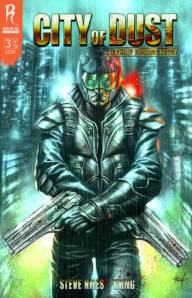 Issue 3 opens with a gruesome scene, of which this series is not shy of, as Khrome uses some old school CSI techniques to determine exactly what happened. His superior, Blake believes Khrome’s mind is slightly askew for not putting his trust in the crime scene bots, who say that there is no evidence amongst the bloody corpse. Facing suspension, Khrome walks away, with fellow cop, Sonja to check out an old evidence storage area. At the same time what appear to be werewolves brutally attack a high society ball. Khrome gets called into Blake’s office, but instead of receiving the expected, “You’ve gone too far! You’re off the case!” type scenario we’ve seen in every Steven Seagal film, Khrome gets a surprise. Blake takes his face off, revealing himself to be a Terminator-like android, created by Henry Ajax. Ajax was once a respected proponent of hi-tech gadgetry, but has now gone underground after being disgraced. Blake and Khrome visit him, surrounded by assorted monsters, and the importance of Khrome’s father in the story takes another step forward. The dramatic change in behaviour from Blake can only be attributed to him “saving face” in front of the other cops, due to the fact that moments later he’s pleasantly talking to Khrome like an old buddy. With Sonja, and now Blake, it seems Khrome’s allies are growing, but they still prefer to remain closet friends, lest they too get in trouble with the harsh authorities. This is never spoken, despite Khrome’s noir-like captions (which work well), so there is some assumption on the part of the reader, which is never a good move. However, the series’ concept and visuals rise above these minor storytelling distractions.
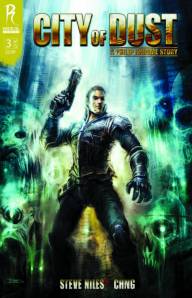 This isn’t the best issue so far, and has less of the supernatural elements introduced in the previous two issues. The art is also different, but not in a jarring way.
  comicbookjesus